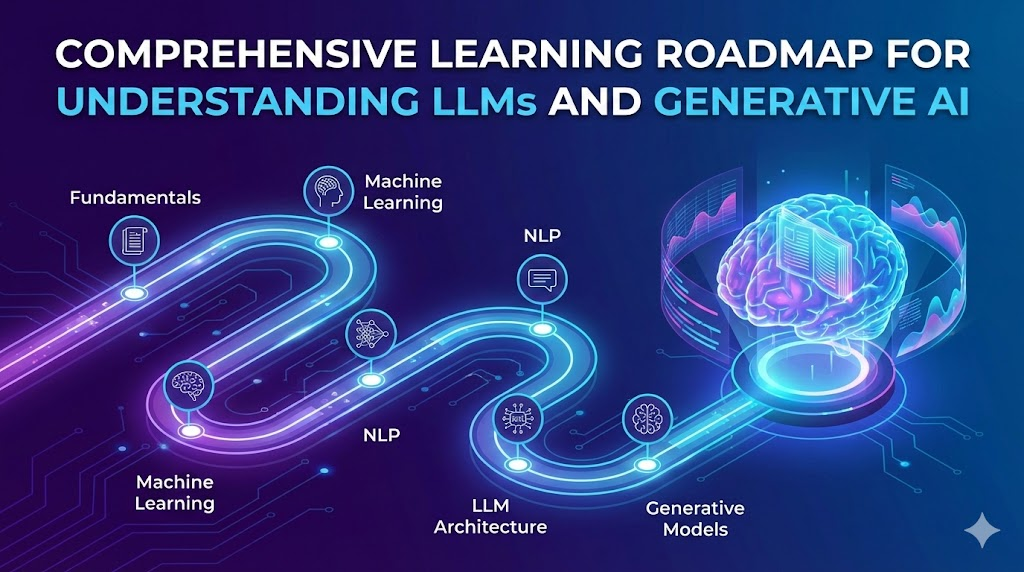
Comprehensive Learning Roadmap for Understanding LLMs and Generative AI

SAMI
December 26, 2025 5 mins to read
Share

Comprehensive Learning Roadmap for Understanding LLMs and Generative AI

Generative AI

Overview

To fully understand Large Language Models (LLMs) and Generative AI, it’s essential to combine theoretical learning with hands-on experience. The Stanford lecture series offers a structured path from fundamentals to advanced topics, while additional free resources provide practical insights and tools. Here’s a step-by-step roadmap that pairs the theoretical aspects with hands-on labs and real-world platforms to solidify your understanding.


Phase 1: Foundation of LLMs and Transformer Models

  1. Lecture 1: Transformer Fundamentals
  • What to Learn:
    • Understanding the architecture of transformer models.
    • Basics of attention mechanisms, self-attention, and positional encoding.
    • Why transformers are so powerful for NLP tasks.
  • Practical Application:
    • Implement a basic transformer model.
    • Experiment with simple datasets (e.g., text classification or translation).
    Resource: Transformer Fundamentals
  1. Lecture 2: Transformer Models + Practical Tricks
  • What to Learn:
    • Common tricks and optimizations in transformer models.
    • Efficient handling of large datasets and memory optimization.
    • Strategies for training transformer models faster and more effectively.
  • Practical Application:
    • Apply these tricks to enhance your transformer model.
    • Experiment with techniques like dropout, layer normalization, and parameter sharing.
    Resource: Transformer Models + Practical Tricks
  1. Lecture 3: Transformers → Large Language Models
  • What to Learn:
    • Evolution from transformers to large language models.
    • How transformers scale up to form LLMs like GPT, BERT, etc.
  • Practical Application:
    • Study the architecture of popular LLMs.
    • Try out pre-trained LLMs using frameworks like Hugging Face.
    Resource: Transformers → Large Language Models

Phase 2: Training LLMs and Fine-Tuning

  1. Lecture 4: How LLMs Are Trained
  • What to Learn:
    • Training pipelines and data requirements for LLMs.
    • The concepts of supervised learning, unsupervised learning, and reinforcement learning in the context of LLMs.
    • Handling large-scale training processes.
  • Practical Application:
    • Set up a simple model for training on a custom dataset.
    • Understand data preprocessing, tokenization, and batch processing.
    Resource: How LLMs Are Trained
  1. Lecture 5: Tuning & Adaptation (Fine-Tuning, etc.)
  • What to Learn:
    • Fine-tuning pre-trained models for specific tasks (text generation, sentiment analysis, etc.).
    • Transfer learning concepts in the context of LLMs.
    • Adaptation techniques like few-shot learning, prompt engineering, and domain-specific tuning.
  • Practical Application:
    • Fine-tune a pre-trained LLM for a specific task using your own dataset.
    • Experiment with few-shot and zero-shot learning techniques.
    Resource: Tuning & Adaptation

Phase 3: Advanced Concepts and Real-World Applications

  1. Lecture 6: Reasoning in LLMs
  • What to Learn:
    • How LLMs perform reasoning tasks such as logic and common sense reasoning.
    • Challenges and strategies for improving reasoning capabilities in LLMs.
  • Practical Application:
    • Explore tools for evaluating reasoning tasks.
    • Experiment with fine-tuning models to improve logical reasoning.
    Resource: Reasoning in LLMs
  1. Lecture 7: Agentic LLMs (Tools, Planning, Workflows)
  • What to Learn:
    • Integration of LLMs into decision-making systems.
    • How LLMs can act as agents with the ability to plan, execute tasks, and manage workflows.
  • Practical Application:
    • Implement agent-like functionality with an LLM, such as scheduling tasks or controlling a chatbot workflow.
    Resource: Agentic LLMs
  1. Lecture 8: Evaluation: What “Good” Really Means
  • What to Learn:
    • Metrics for evaluating LLM performance (e.g., perplexity, BLEU score, ROUGE score).
    • The trade-off between accuracy, fluency, and other evaluation criteria.
  • Practical Application:
    • Implement different evaluation metrics to assess your LLMs and fine-tune accordingly.
    • Test models on benchmark datasets to understand performance nuances.
    Resource: Evaluation: What “Good” Really Means

Phase 4: Staying Up-to-Date and Exploring Current Trends

  1. Lecture 9: Recap + What’s Trending Now
  • What to Learn:
    • A recap of everything covered in the series.
    • Latest advancements in the LLM and generative AI space.
  • Practical Application:
    • Analyze current papers, articles, and projects in the LLM space to stay current.
    • Explore the integration of cutting-edge techniques like multi-modal learning and conversational AI.
    Resource: Recap + What’s Trending Now

Phase 5: Supplementary Practical Resources

To complement the theory from Stanford, utilize the following free resources to build practical skills:

  1. Microsoft – Generative AI for Beginners (FREE)
  • What to Learn:
    • Comprehensive overview of generative AI, including core principles, applications, and models.
  • Resource: Generative AI for Beginners
  1. NVIDIA Developer Program (FREE access to tools, SDKs, learning)
  • What to Learn:
    • Access to NVIDIA’s tools and resources for developing AI models and deploying them on GPUs.
  • Resource: NVIDIA Developer Program
  1. Google Cloud – ML & AI Training (FREE tracks)
  • What to Learn:
    • In-depth training on machine learning and AI models using Google Cloud’s platform and services.
  • Resource: Google Cloud ML & AI Training

Suggested Approach

  1. Mini Bootcamp: Treat this learning journey as a mini-bootcamp. Dedicate time to watch one lecture at a time and implement small experiments.
  2. Note-Taking: Take detailed notes during lectures and pause often to reflect and explore further.
  3. Hands-On Implementation: After each lecture, implement what you’ve learned through small projects and experiments.
  4. Iterate & Learn: Continuously apply the theoretical knowledge on real-world platforms to build your intuition.
  5. Stay Updated: Follow trends in the industry to ensure you’re aligned with the latest advancements.

This roadmap will guide you from the foundational knowledge of LLMs and transformers to advanced concepts, ensuring that you not only understand theory but also gain the practical skills needed for real-world applications. By combining theory with hands-on experience, you’ll be well-prepared to build, fine-tune, and deploy generative AI models in 2026 and beyond.

https://cme295.stanford.edu/syllabus

Leave a comment

Your email address will not be published. Required fields are marked *