
(Speaker stands center stage, smiling and looking across the audience. The atmosphere is buzzing with chatter and excitement.)
Hello everyone, and welcome to TuniHack 11.0! (enthusiastic tone, arms open wide in welcome) I can’t tell you how excited I am to see this hall filled with energy tonight. To all the university students, mentors, and tech enthusiasts here – good evening and thank you for being part of this adventure! This isn’t a stiff corporate event; this is a celebration of innovation and community (big smile, sweeping gesture) – our very own 24-hour tech festival where anything is possible.
(Speaker pauses, letting the energy in the room build, and makes eye contact around the room.) I’m Sami BELHADJ , a proud co-organizer of TuniHack 11.0 and Senior IT Manager. I’ve been to many hackathons around the world, but let me tell you – there’s nothing quite like TuniHack. The vibe here is something special[1]. You’ll soon feel it: the camaraderie, the creativity, the caffeine – and yes, the occasional 3 A.M. burst of genius. We’ve got students from all over Tunisia (and beyond) under one roof tonight, united by one goal: to build something amazing together. (Energetic emphasis on “build something amazing,” accompanied by a pumped-up fist in the air.)
(Speaker glances at watch playfully.) We have about 24 hours ahead of us – 24 hours of coding, brainstorming, maybe a bit of dancing-in-your-seat, and definitely a lot of coffee. But before we dive into this marathon, I want to kick things off on the right note. So let’s start with some very important thank-yous. (Transition with a warm smile.)
First, a heartfelt thank you to the ENSI university leadership – the directors, faculty, and staff who have supported TuniHack from day one. (Addressing any officials present, hand over heart.) Thank you for believing in student innovation and for opening your doors to let this crazy, wonderful event take flight. Your support means we get to turn this campus into an innovation playground for a whole day[2]. We truly appreciate how ENSI nurtures creativity and allows events like this to become an 11-year (and counting!) tradition.
Next, I want to shine a spotlight on the heroes behind the scenes – the OSSEC Club and its members. OSSEC (that’s the Open Source Software ENSI Club) is the student-driven powerhouse that organizes TuniHack every year[3][4]. (Gestures toward the organizers in their matching T-shirts.) These folks have been working for months (many late nights, trust me) to make sure everything is just right for you. They’ve poured their hearts into planning this hackathon – from securing sponsors to planning fun activities at 2 A.M. – all because they love this community and want to see you all shine. Let’s give the OSSEC team a big round of applause! (Leads audience in applause, smiling toward organizers.) Thank you for embodying the club’s motto of “Dare to Share,” and for creating a space where we can all learn and build together[4][5]. Your open-source, knowledge-sharing spirit truly sets TuniHack apart from any other hackathon[5].
And of course, thank you to all the participants and teams here tonight. Whether you’re an ENSI student or visiting from another university, whether this is your 5th hackathon or your very first – we’re thrilled you’re here. You’ve opted to spend the next 24 hours pushing your limits, collaborating with new friends, and creating something from scratch. That’s a bold and awesome decision! (Points gently across the audience.) Give yourselves a round of applause, because just by being here, you’re already part of something special. You are now officially part of the TuniHack family – a community that’s been growing for eleven years strong.
(Speaker takes a brief pause, scanning the room with an appreciative smile. Time check: this section ~2 minutes so far. The mood is warm and upbeat.)
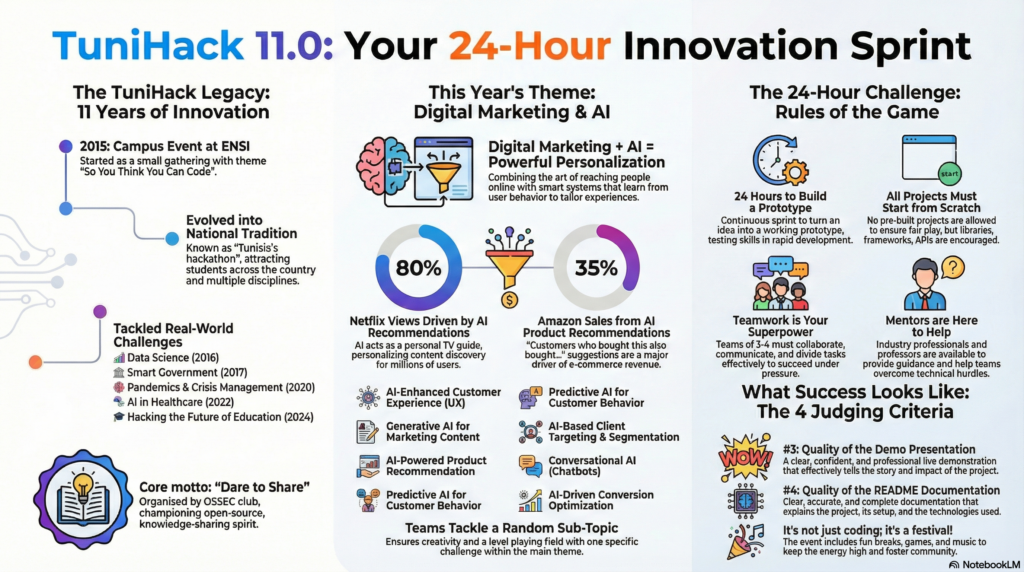
Let’s talk about TuniHack’s journey for a moment, because you all are about to write the next chapter of a pretty amazing story. Eleven years ago, back in 2015, TuniHack started as a humble campus event right here at ENSI[6]. Picture a small lecture hall with a handful of passionate students hacking away, fueled by curiosity (and probably some soda and chips). The theme that very first year was fittingly called “So You Think You Can Code” – and boy, did they prove they could! (Chuckles, inviting the audience to imagine it.)
Fast forward to today: TuniHack has blossomed into a national hackathon tradition[6]. It’s one of Tunisia’s most popular hackathons[7] – in fact, it’s often lovingly called “Tunisia’s hackathon”, a yearly milestone for our tech community[8]. Students from universities all across the country – and even different disciplines – flock here each year to take part[6]. What started as an ENSI event is now a country-wide innovation festival, drawing computer science majors, engineering students, business students, even artists and anyone with a creative spark. That growth, that diversity, is TuniHack’s strength and pride.
Every edition of TuniHack brought something new. We’ve had themes over the years that tackled the latest tech trends and real-world challenges. (Uses fingers to count off some past themes with enthusiasm.) In 2016, the theme was Data Science – pretty forward-thinking. 2017 went Smart Government, asking hackers to fight bureaucracy with code. In 2020, during some challenging times, we did Pandemics and Crisis Management (how timely was that?). 2022 focused on AI in Healthcare, spurring ideas to help doctors and patients. And just two years ago, TuniHack 10.0 challenged us with “Hacking the Future of Education” in 2024[9]. Each year, a new domain, a new set of problems to solve. One year you might build a fintech app; the next, you’re gamifying an education platform[10]. The variety keeps us on our toes and keeps this hackathon fresh and exciting. It also shows something important: TuniHack isn’t just about coding in isolation – it’s about using tech to tackle real-world issues across different industries[11].
What’s truly remarkable is that through all this growth, TuniHack has kept its soul. It still feels youthful, crazy, and cutting-edge – just as it did in that first edition. After a decade, the hackathon remains a launchpad for creativity and ingenuity[12]. We’ve seen students come in with wild ideas and leave having built prototypes that blow everyone away. Some projects even go on to become startups or open-source projects. The community around TuniHack just keeps getting bigger and more ambitious, but it’s as friendly and supportive as ever. Professors, industry professionals, and alumni often join in now – either as mentors or judges or just cheerleaders – because they know this is the place to see innovation in action.
And tonight, edition 11.0 isn’t just another event – it feels like an anniversary. (Proud tone.) It’s a celebration of eleven years of passion, innovation, and talent coming together[13]. Think about that: for eleven years, students like you have dared to innovate and share their ideas at TuniHack, and in doing so, they caught the attention of the entire nation’s tech industry[13]. TuniHack’s story is about collaboration – between academia and industry, between experienced mentors and fresh beginners, between different fields of study – all meeting at this one crazy, sleepless, wonderful event each year[14]. By sitting here tonight, you are becoming part of that story, part of that legacy. (Speaker slows slightly for emphasis, making eye contact left, center, right.) Feel that for a second. It’s pretty inspiring, right? You’re joining a long line of TuniHackers who’ve proven that 24 hours, some teamwork, and a lot of creativity can accomplish incredible things.
(Speaker shifts tone from reflective to excited.) So let’s carry that energy forward into what we’re doing this year. Are you ready to hear what theme you’ll be tackling for the next 24 hours? (Grins knowingly, hand to ear as if expecting a reaction. The audience likely cheers or leans in.)
That’s right, our theme for TuniHack 11.0 is “Digital Marketing and Artificial Intelligence.” (Says it clearly and pauses for a beat, looking around to gauge reactions.) Now, you might be thinking: whoa, that sounds broad… and kinda cool. It is! Let me break it down so everyone’s on the same page.
Digital Marketing is basically how organizations connect with people online – through social media, search engines, emails, you name it. It’s the art and science of getting the right content to the right people at the right time (and maybe convincing you to click that “Buy” button or hit “Subscribe”). AI, or Artificial Intelligence, is about machines and software mimicking human intelligence – learning from data, making predictions, even “thinking” in a way. When you combine these two – Digital Marketing + AI – you get something really powerful: smart systems that can understand user behavior and automatically tailor marketing to fit each person.
And guess what – you experience this every day. (Now adopt a conversational, relatable tone, walking a few steps to one side of the stage.) Think about when you’re on Netflix or YouTube. Ever noticed how it serves up eerily perfect suggestions for what to watch next? That’s AI-driven recommendation at work. In fact, Netflix has said that over 80% of the content viewed on Netflix comes from its AI-powered recommendations[15]. 80%!! That’s basically Netflix’s AI acting as your personal TV guide, and it’s a huge part of why we all binge a bit too much. Now consider Amazon – you know those “Customers who bought this also bought…” product suggestions? Turns out those personalized recommendations drive a big chunk of Amazon’s sales – roughly 35% of what people buy on Amazon comes from AI product recommendations[16]. Crazy, right? AI + marketing is big because it works.
(The speaker moves to the other side of the stage, keeping the energy up.) How about social media? If you’ve ever wondered, “Why do I keep seeing ads for sneakers right after I searched for running shoes?” – well, that’s AI in digital marketing doing its thing. Platforms like Instagram, TikTok, Facebook – they use AI algorithms to analyze what you like, who you follow, what you talk about, and then they show you content and ads tailored just for you. Those funny or spooky moments when an ad feels too perfectly targeted? Yep, that’s data and AI behind the scenes.
And then there are chatbots – you’ve probably encountered those chat pop-ups on websites (“Hi! Need help? 🤖”). Many companies use AI-powered chatbots on their sites or on Messenger/WhatsApp to handle customer questions or even recommend products. They’re basically AI sales reps working 24/7. A lot of us prefer to quickly ask a bot about a product’s price or a store’s return policy – and if that bot also says “Hey, we have a 20% off on that item today!”, that’s AI-driven marketing right there.
Even in content creation: AI can write simple marketing emails, generate social media posts, or personalize the content you see. Think of Spotify’s Discover Weekly playlist – it’s like a personalized music marketing campaign created by AI to keep you engaged with the app by finding songs you specifically might like. Or your email inbox – ever get those “We miss you, here’s a discount!” emails from apps you haven’t used in a while? AI likely helped figure out when to send that and what to offer, based on predicting what would win you back.
So Digital Marketing and AI together are everywhere in the real world, shaping how we discover products, content, and experiences. It’s not just theory – it’s Netflix keeping you binging, Amazon getting you to add one more item to your cart, and your favorite apps knowing just when to ping you with that “Don’t forget to check this out!” notification. It’s a perfect theme for a hackathon because it touches tech, business, user experience, data science – a bit of everything. And it’s super relevant to us as consumers and as builders. I mean, who here uses at least one streaming service or social media platform? (Raises hand playfully; audience likely mirrors.) See, we’re all immersed in this stuff daily.
Your challenge in TuniHack 11.0 is to come up with innovative ideas at the intersection of digital marketing and AI. Think of ways AI can make marketing more engaging, more personalized, maybe less annoying, maybe more accessible – the field is wide open. And to make it even more exciting, we’re throwing in a twist: you won’t all be doing the same project or problem. Each team will work under the umbrella of Digital Marketing + AI, but each team will get a specific sub-theme or challenge to focus on. (Animated, to emphasize the surprise element.) In true hackathon style, the exact prompts are secret until we kick off hacking[17]. Very shortly, we’ll reveal those sub-challenges – likely by a random draw. You might end up focusing on, say, AI-powered social media analytics, or personalized e-commerce experiences, or maybe AI-driven content creation tools for marketers – who knows! You’ll find out in a few minutes, and that mystery is part of the fun.
Why do we do that? Because walking in, no one can have a fully pre-made plan – it levels the playing field for everyone[17]. It forces you to think on your feet and get those creative gears turning the moment the theme is revealed[18]. Trust me, when we announce those sub-themes and you huddle up with your team to brainstorm, there’s going to be a jolt of energy in this room. It’s one of my favorite moments – seeing all of you go from “What will it be?” to “Okay, idea time, let’s do this!” in seconds. Embrace that adrenaline rush; it’s what hackathons are all about!
(Speaker takes a quick breath and sip of water – we’ve covered a lot. The energy remains high. Timing check: ~8-10 minutes elapsed in speech.)
Now, let’s talk about what the next 24 hours actually look like for you. Here’s the game plan (and yes, it’s as crazy and awesome as it sounds):
(By now, the audience should feel both excited and more at ease about how to proceed. Speaker maintains an upbeat tone.)
Now, I know this all sounds intense. 24 hours to make something, maybe on a topic you just learned about… that’s a challenge. But here’s the thing: these constraints – the ticking clock, the surprise theme, the limited scope – they’re not limitations, they’re creative fuel. Some of the most innovative hacks come precisely because you had to MacGyver a solution under pressure. When you don’t have time to overthink, you often build the simplest, most clever version of an idea. So embrace the chaos! If at 3 A.M. you find yourself thinking “Why did I sign up for this?”, remember: because it’s fun and it’s pushing you to grow. You will learn more in one night here than you could in weeks on your own. And no matter what happens – whether your demo crashes or your code base catches fire (figuratively!) – you will have gained so much by tomorrow. (Smiles reassuringly.) Every “failure” is just a funny story to tell later and a lesson learned, and every success feels like a triumph won against the odds.
(Quick pause for effect, then transition to judging criteria with a forward-looking tone.)
Alright, let’s switch gears to something more practical – how your projects will be judged once the 24 hours are up. Now, I want you to see these criteria not as a nitpicky checklist, but as a roadmap to wow the judges. This is what you should aim for to make your project stand out. There are four criteria, in order of priority: (holds up four fingers and then counts them down)
(Speaker pauses and looks at the audience with an encouraging smile.) So those are the four pillars of judging: Wow factor, Tech Innovation, Demo Quality, and Documentation. Keep them in mind as you hack. If you find your team stuck at any point, revisit this list: Are we pushing for originality? Are we using tech smartly? Have we thought about how to demo this compellingly? Are we keeping notes for our README? Use these criteria as a guide to refocus. Ultimately, they’re here to help you produce a project you’re proud of. And remember, every team here has a shot – we care about these qualities more than completeness or polish. A rough prototype that wows us is better than a perfectly polished app that’s just “meh.”
(Time check: ~15 minutes in. The speech is now heading to a conclusion with high inspiration.)
Now, as we gear up to start this hackathon, I want to leave you with a few thoughts. Hackathons are magical. In the next 24 hours, you’re going to experience highs, lows, and everything in between. You’ll have moments of pure inspiration where an idea clicks or a bug suddenly gets solved (cue the victorious “YES!”). You’ll probably also have moments of frustration – when the code isn’t working at 2 A.M. and you’re bleary-eyed, or when you realize the approach you took at midnight needs a major pivot at 6 A.M. (knowing chuckle, acknowledging the struggle). But all of that is part of the journey. And you are not alone in it – look around you. This room is full of people on the same crazy ride, supporting each other. The community aspect is what makes TuniHack so special[1]. If you need help or just a morale boost, talk to the team next to you, call over a mentor, or find an organizer. We’ve got an environment where collaboration is just as important as competition[1]. Everyone here wants everyone else to succeed – it’s about collective growth and learning.
Also, don’t forget to have fun! Yes, this is a competition, but it’s also a celebration. Play the mini-games, take a selfie at the photo booth (did I mention we have one in the back?). Tweet or gram your hackathon experience (use #TuniHack11 – let’s get it trending!). Make new friends – the person sitting next to you might be your future co-founder, or at least a new LinkedIn connection who can endorse you for “C++” tomorrow. Enjoy the little things – the midnight snacks, the shared laughs over a silly error, the moment when someone blurts out a hilariously bad idea and you all giggle (sometimes those bad ideas spark great ones). These 24 hours will go by faster than you think, and I promise you’ll remember them.
(Speaker’s voice grows more impassioned, urging everyone on.) I want each of you to push your boundaries. Try something you’re not expert in. If you’re a frontend developer, dabble with an AI API. If you’re a data science nerd, maybe stretch into a mobile app interface. Take risks – this is the perfect low-stakes environment to try that crazy framework or to code in a new language. If it fails, who cares? You learned something. If it succeeds, you’ve got an edge and a great story. We, the judges and mentors, will cheer just as hard for a daring attempt as for a polished final product. So be bold.
In these events, there’s a saying: “Nobody really loses at a hackathon.” Sure, some teams will win prizes and kudos (and we have some cool prizes, by the way, not that you needed more motivation). But every single one of you will come out of this having gained new skills, new connections, and new confidence[24]. You’ll have a project you can point to and say, “We built this in a day.” That is huge. Whether or not your project works perfectly, you will have created something and challenged yourself – and that’s a win in itself.
As the organizers put it, TuniHack isn’t just an event; it’s a community and a culture[13]. For eleven years, students have dared to innovate here, and tonight you carry that torch forward. So give it your all. Help each other. Share your knowledge. “Dare to share,” as OSSEC always says. If you figure something out at 5 A.M. that could help a team nearby, why not lend a hand? That spirit makes everyone better. In the end, we all come out as winners because we all learn and grow[25][26].
(Now the speaker moves to center stage, building to a rallying finish.)
Good luck to each and every one of you. I genuinely cannot wait to see the amazing ideas and prototypes you come up with by this time tomorrow. Remember to be creative, be courageous, and above all, have fun. This is your time to shine, to turn that spark in your mind into something real. We’re all here rooting for you – the mentors, the judges, the organizers – we’re on your side, excited to be wowed by what you do.
So, are you ready to hack? (Raises voice and energy, looking around the room.) Are you ready to innovate, collaborate, maybe code till dawn and create something incredible? (Encourages audience to respond – maybe they cheer or holler.) I think you are!
On behalf of the entire TuniHack team, I wish you happy hacking. Push boundaries, break things (in code, not the furniture please!), make memories, and most importantly, enjoy the journey.
Let’s do this! TuniHack 11.0 starts now – good luck and have a blast! (Raises both hands in the air victoriously as the audience cheers. Speaker nods and smiles, then steps aside to officially begin the hackathon.)