

How a small model learns to do one job as well as a large one, what it costs, and when it is the wrong idea.
Conceptual and procedural guide. Last reviewed August 2026.
Distillation is the technique behind most small models that punch above their weight, and behind a large share of the cost reduction teams achieve after their first year in production with a frontier model. The word covers several different procedures, which is why two engineers can agree that they are “distilling a model” and mean incompatible things.
This article explains the mechanism, the variants, the published evidence, and the decision itself. It is written to be read at three depths:
Prerequisites: familiarity with what a token is, what fine-tuning does, and what an API call to a hosted model costs. No training experience is assumed until the mechanics section, which uses probability notation.
Model distillation trains a small model, the student, to reproduce the behaviour of a large model, the teacher, on a defined task. The teacher supplies the training signal. Instead of learning from human-written labels, the student learns from what the teacher produces: its generated text, its output probabilities, or its judgement of the student’s own attempts.
The result is a model that is cheaper and faster to serve, and that is usually good at one narrow thing rather than at everything. The teacher stays available for the requests the student cannot handle.
Geoffrey Hinton, Oriol Vinyals and Jeff Dean introduced the modern formulation in 2015 for image classifiers. Language models inherited it and added variants that suit sequences of tokens rather than single labels.
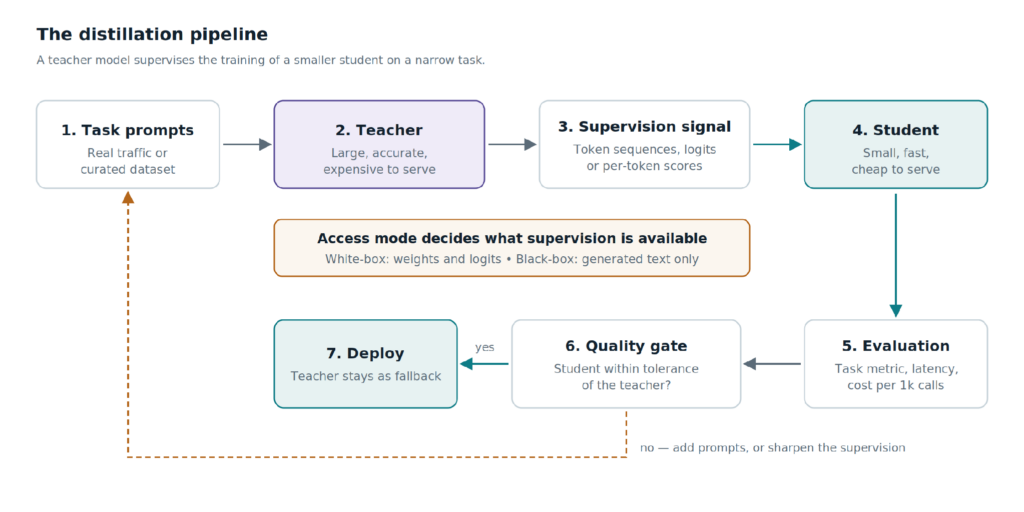
Figure 1. The seven stages of a distillation project. The loop matters more than any single stage: without step 5 you cannot tell whether the student is ready.
| Not the same thing: distillation trains a new model. Quantisation and pruning compress an existing one without changing what it learned. Retrieval augmentation changes what the model sees at inference time, not what it knows. These are complementary and often stacked, but they solve different problems. |
Four motivations come up repeatedly, and they are not equally common.
| Motivation | What it looks like in practice |
|---|---|
| Unit cost | A classification, extraction or routing task runs millions of times a month on a frontier model. The same task on a 3B or 8B student costs a fraction of that. |
| Latency | The workload sits in a user-facing path where the frontier model’s time to first token is too slow, or where a long reasoning trace is not worth waiting for. |
| Locality and control | The model must run inside a controlled perimeter, on your own hardware, without sending data to a third party. That rules out the frontier model and leaves you with a small one that needs to be taught. |
| Behaviour recovery | A model was fine-tuned on internal documents and lost the instruction-following behaviour it used to have. Distillation from the pre-fine-tuning version restores it. |
The fourth is the least known and the most useful to enterprise teams. It is treated in more detail under “What the numbers say”.
The economics only work when the task is narrow. A student trained to match a teacher on invoice extraction will not match it on anything else, and every task you add multiplies the training and evaluation work.
Three distinct procedures travel under the same word. Reading a vendor page or a paper without knowing which one is meant leads to wrong expectations about cost and quality.
| Name | What the student sees | Requires |
|---|---|---|
| Logit distillation (white-box) | The teacher’s full probability distribution over the vocabulary at every position | Teacher weights, or an API that returns full logits. Same or mapped tokenizer. |
| Sequence-level distillation (black-box) | Only the text the teacher generated. Standard supervised fine-tuning on that text. | API access. This is what most managed services do. |
| On-policy distillation | The teacher’s per-token scoring of text the student itself generated | Ability to query teacher log-probabilities on arbitrary token sequences. |
A fourth usage is looser: teams say “we distilled GPT into our model” when they mean they fine-tuned on a few thousand teacher answers. That is sequence-level distillation, and calling it by its name makes its limits easier to predict.
This section assumes you want to know why the methods differ, not only that they do.
A one-hot training label says one token was right and all others were equally wrong. The teacher’s distribution says more than that. It ranks the alternatives, and the ranking carries information about the structure of the task.
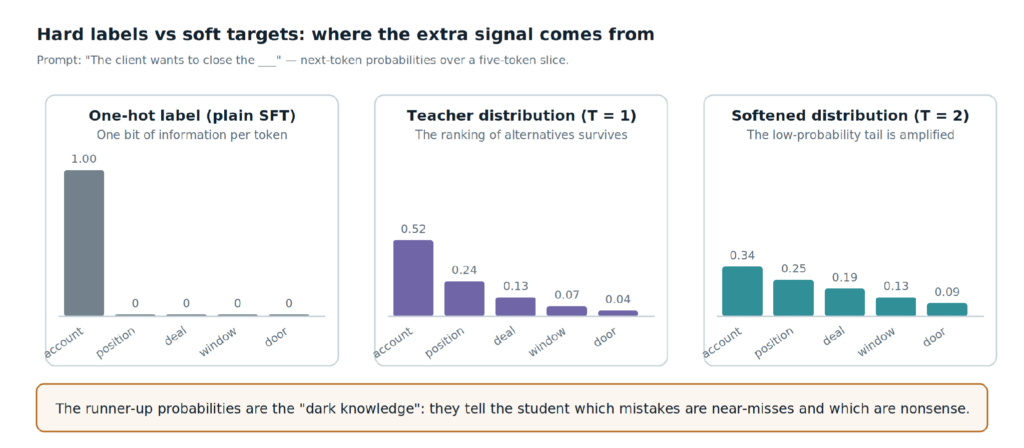
Figure 2. The same prediction under three supervision regimes. The one-hot label discards the information that “position” was a close second and “door” was not.
Hinton’s paper calls these runner-up probabilities dark knowledge. To make them usable you raise the softmax temperature, which flattens the distribution and pulls the informative tail up out of the numerical floor. Both teacher and student are softened by the same temperature during training. The student is served at temperature 1.
The gradients produced by a softened distribution scale roughly as 1/T squared, so the distillation term is multiplied by T squared to keep its weight stable when you change the temperature.
import torch, torch.nn.functional as Fn

def kd_loss(student_logits, teacher_logits, labels, T=2.0, alpha=0.7):
    """Classic offline KD: soft teacher targets + the hard label."""
    soft_t = Fn.softmax(teacher_logits / T, dim=-1)
    soft_s = Fn.log_softmax(student_logits / T, dim=-1)
    # forward KL(teacher || student), scaled to keep gradients comparable across T
    kd = Fn.kl_div(soft_s, soft_t, reduction="batchmean") * (T * T)
    ce = Fn.cross_entropy(student_logits, labels)
    return alpha * kd + (1.0 - alpha) * ce
Two properties are worth remembering. The loss is zero when the two distributions are identical, and it stays comparable in magnitude as you vary T, which is the point of the T squared factor. In a language model, this is applied per position over the sequence.
The choice of divergence decides what the student does when it cannot match the teacher everywhere, and small models frequently cannot.
| Divergence | Behaviour | Consequence |
|---|---|---|
| Forward KL, teacher relative to student | Mode covering. The student spreads probability mass over everything the teacher might say. | A student with too little capacity hedges, producing bland or averaged output. |
| Reverse KL, student relative to teacher | Mode seeking. The student commits to one of the teacher’s behaviours. | Sharper, more decisive output. This is what on-policy methods optimise. |
Reverse KL has a practical advantage as a reward signal: it cannot be gamed. A low value always means the teacher would have been comfortable with what the student said, which is not true of a learned reward model.
The second axis is more consequential than the loss function. Off-policy means the student trains on text the teacher wrote. On-policy means it trains on text it wrote itself, with the teacher scoring it.
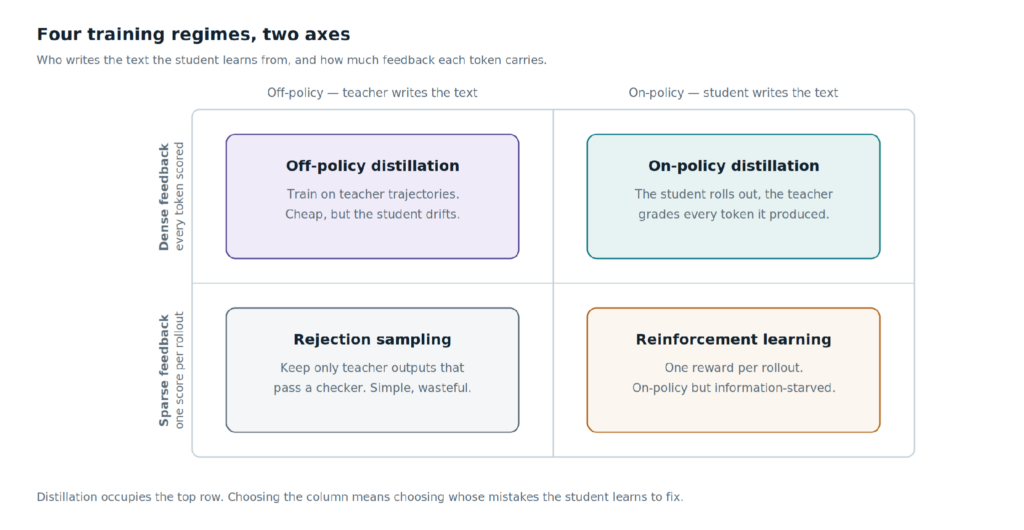
Figure 3. The two axes that separate the methods. Reinforcement learning shares the on-policy column with on-policy distillation, but gives one number per rollout instead of one per token.
Off-policy training has a failure mode that gets worse as outputs get longer. The student learns to continue from states the teacher visits. At inference it will occasionally produce a token the teacher never would, and from that point it is in territory no training example covered. The error compounds.
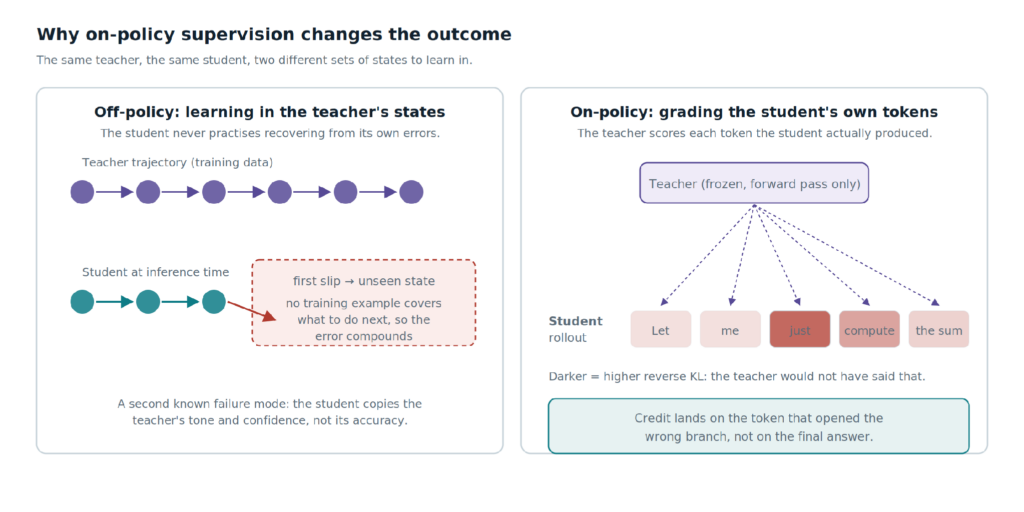
Figure 4. Left: the compounding error problem, sometimes called exposure bias. Right: on-policy grading, where every token the student produced receives a score from the teacher.
There is a second, subtler problem with imitating text alone. Research on imitating proprietary models found that students learn the teacher’s style and confidence faster than its factual accuracy, which flatters human evaluations while leaving benchmark performance behind.
On-policy distillation addresses both. The student samples its own trajectories, the frozen teacher computes log-probabilities over those exact tokens, and the per-token reverse KL becomes the training signal. Credit lands on the token that started the wrong reasoning branch rather than on the final answer, which is often perfectly predictable given everything that came before it.
# On-policy distillation, adapted from the Tinker cookbook recipe
teacher = service.create_sampling_client(base_model=TEACHER)

for step in range(n_steps):
    # 1. the STUDENT generates; this is what makes it on-policy
    traj = do_group_rollout(student_client, prompts)
    student_lp = traj.loss_fn_inputs["logprobs"]

    # 2. the frozen teacher scores those same tokens (one forward pass)
    teacher_lp = teacher.compute_logprobs(traj)

    # 3. per-token reverse KL becomes a per-token (negative) advantage
    traj["advantages"] = -(student_lp - teacher_lp)

    # 4. ordinary policy-gradient update
    training_client.forward_backward(traj, loss_fn="importance_sampling")
Three things follow from this shape. You never need a separate reward model or a human labeller. You never need to wait for a rollout to finish, since the score exists for partial sequences, so training can run at shorter context than evaluation. And on an existing reinforcement learning stack that already regularises against a reference model, the change is close to swapping which model plays that role.
| Note: the per-token reverse KL of a single sampled token can be negative. It is the expectation over the student’s own distribution that is non-negative, and that is what the update optimises. |
The clearest published comparison comes from the Qwen3 technical report, where the same initialisation was pushed further by two different methods.
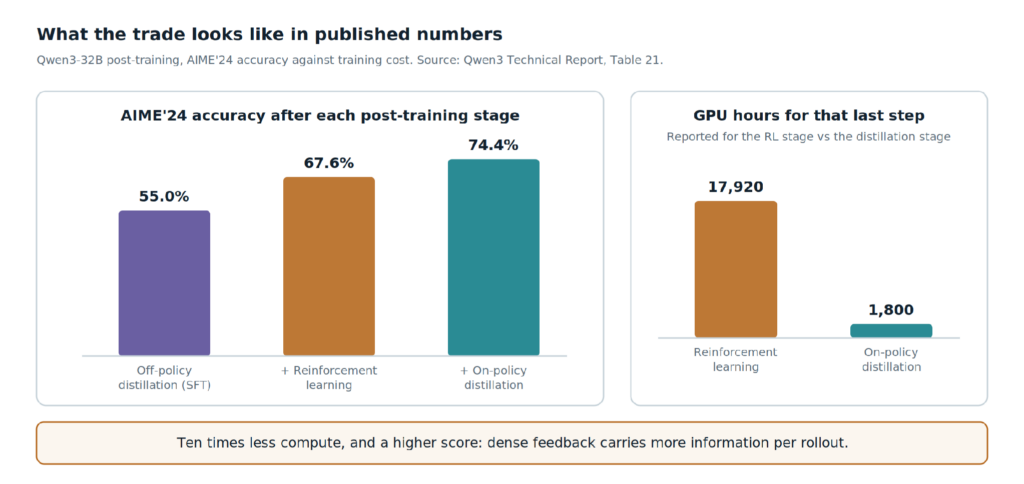
Figure 5. Accuracy and cost for the final post-training stage. The distillation stage reached a higher score than the reinforcement learning stage for about a tenth of the GPU hours.
Thinking Machines Lab reproduced the pattern independently. Starting from a student fine-tuned on 400,000 teacher-generated prompts, which scored 60 percent on AIME 2024, on-policy distillation reached 70 percent in roughly 150 steps. Reaching the same score by continuing supervised fine-tuning was estimated to need about 2 million prompts. Counted in FLOPs, the reduction was 9 to 30 times depending on whether you already own the fine-tuning dataset.
A separate self-distillation experiment isolated the effect of feedback density. A model was trained with reinforcement learning, then that trained model was distilled back into the original base model. The distillation run recovered the same score in 7 to 10 times fewer gradient steps.
A more relevant experiment for internal deployments: an 8B assistant was mid-trained on internal company documents to teach it domain knowledge. Its knowledge score rose from 18 to 43 percent. Its instruction-following score collapsed from 85 to 45 percent. Mixing 30 percent general chat data into the training set limited the damage but never removed it.
On-policy distillation from the model’s own earlier version, using only general chat prompts and nothing from the document set, restored instruction following to 83 percent while knowledge stayed at 41 percent. The document training and the behaviour repair are separable, which makes a practical loop possible: teach new knowledge, then repair behaviour, then repeat as the documents change.
| Stage | Internal knowledge | Instruction following |
|---|---|---|
| Original 8B model | 18% | 85% |
| After training on internal documents only | 43% | 45% |
| With 30% general chat data mixed in | 36% | 79% |
| Plus on-policy distillation from the original | 41% | 83% |
Managed services publish their own numbers, which describe sequence-level distillation and should be read as vendor claims rather than independent results. AWS states that distilled models on Bedrock run up to 500 percent faster and cost 75 percent less than the original, with under 2 percent accuracy loss on retrieval-augmented use cases. Treat those as the shape of the opportunity and measure your own task.
On the research side, black-box methods keep improving. Microsoft Research reported that a 14B student trained with a generative-adversarial variant of on-policy distillation, using only teacher text, became comparable to its much larger teacher on an automatic chat evaluation.
Work down this table until a row matches your access and your constraints.
| Situation | Method | Practical note |
|---|---|---|
| Teacher is an open-weight model you can host | Logit or on-policy distillation | Best quality per unit of compute. Tokenizer must match, or be mapped. |
| Teacher is a commercial API, task is narrow and stable | Sequence-level, via a managed distillation service | Lowest effort. Check the terms before you start. |
| Student must recover behaviour lost to fine-tuning | On-policy distillation from an earlier checkpoint of the same model | The teacher here is your own past model, which removes all licence questions. |
| You need reasoning, not just format compliance | Off-policy warm start, then on-policy | The warm start puts the teacher’s behaviour inside the student’s reach; the on-policy phase makes it reliable. |
| You have prompts but no correct answers | Rejection sampling, then distillation | Generate many teacher answers, keep those a checker accepts, train on those. |
Most workloads that look like distillation candidates are not. Run the four checks before writing any training code.
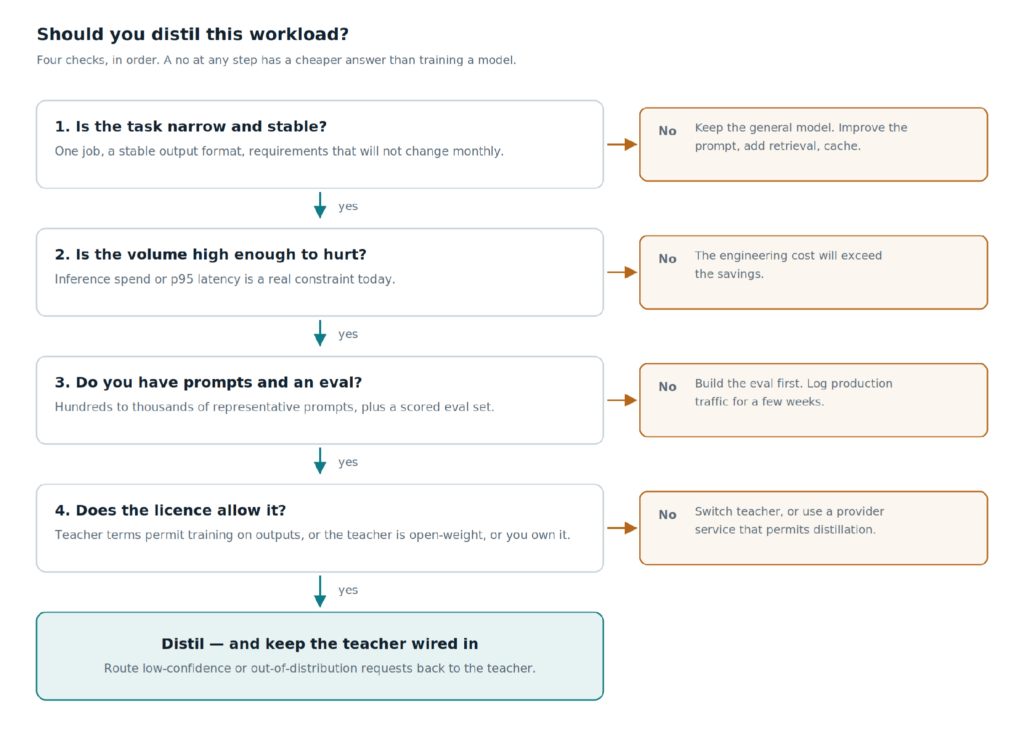
Figure 6. Four checks in order. Failing any of them has a cheaper answer than training a model.
The eval is the check teams skip, and it is the one that decides whether the project can finish. Without a scored evaluation set you cannot answer the only question that matters at the end: is the student close enough to the teacher to take over?
Before starting, you need: a defined task with a stable output format, at least several hundred representative prompts and preferably a few thousand, a scored evaluation set that is disjoint from the training prompts, a chosen student model, and written confirmation that the teacher’s terms allow what you are about to do.
If you do not want to own the training loop, three services cover the sequence-level case.
The trade is control. You cannot export the training file in some of these workflows, and you cannot use the teacher to distil into a model the provider does not host.
| Symptom | Likely cause | What to do |
|---|---|---|
| Good on the eval set, poor in production | Training prompts came from a different distribution than real traffic | Rebuild the prompt set from production logs, including malformed inputs |
| Fluent and confident but factually worse | The student imitated style faster than substance, a known effect of text-only imitation | Move to per-token supervision, or add a verifiable checker to the training loop |
| Degrades on long outputs only | Compounding error from off-policy training | Switch the final phase to on-policy distillation |
| Lost general ability after training on internal data | Catastrophic forgetting during mid-training | Distil from the pre-training checkpoint on general prompts to restore behaviour |
| Output is bland or hedged | Forward KL with insufficient student capacity, so the model covers every mode | Use reverse KL, or accept that the student is too small for the task |
| Quality drops after a teacher upgrade | The student was frozen against an older teacher | Pin the teacher version, re-run evaluation on every teacher change |
The technique is standard machine learning. The exposure comes from where you point it.
Copyright is a weak theory in most jurisdictions, because model outputs typically lack the human authorship that copyright requires. The live questions are contractual and, increasingly, trade secret. Most frontier providers prohibit using their outputs to train competing models, and some prohibit training any model on their outputs without permission.
Two disputes made this concrete. OpenAI accused DeepSeek of using its models to train a competitor in violation of its terms of use. Anthropic later said it had identified large-scale campaigns by DeepSeek, Moonshot and MiniMax to extract Claude’s capabilities through thousands of fraudulent accounts, while acknowledging that distillation itself is a legitimate training method. Neither case turned on whether distillation is allowed as a technique.
Practical positions, from safest to riskiest:
For a regulated environment, add documentation to the deliverable: teacher model and version, prompt provenance, generation parameters, evaluation results, and the licence review. A distilled model is a derived asset and its lineage belongs in your model inventory.
If distillation fits your workload, the fastest useful experiment is small: pick one high-volume task, build the 200-case evaluation set, and run a sequence-level distillation through a managed service. That answers the economic question in days. The on-policy work is worth the extra effort only once you know the size of the prize.
Hinton, Vinyals and Dean, Distilling the Knowledge in a Neural Network (2015). The origin of soft targets and temperature scaling.
Kim and Rush, Sequence-Level Knowledge Distillation (2016). The adaptation to sequence models.
Agarwal et al., On-Policy Distillation of Language Models (2023), and Gu et al., MiniLLM (2023). The on-policy and reverse-KL foundations.
Gudibande et al., The False Promise of Imitating Proprietary LLMs (2023). Why style transfers faster than accuracy.
Thinking Machines Lab, On-Policy Distillation (2025), with runnable recipes in the Tinker cookbook.
Qwen Team, Qwen3 Technical Report (2025). Source of the accuracy and GPU-hour comparison.
AWS, Customize a model with distillation in Amazon Bedrock, and OpenAI, Model Distillation in the API. The managed workflows.
Fenwick, DeepSeek, Model Distillation, and the Future of AI IP Protection. A legal overview of the contractual and trade secret arguments.
