

On July 9, OpenAI moved the GPT-5.6 family to general availability, two weeks after a limited preview. There is no single “GPT-5.6.” There are three: Sol, Terra, and Luna. If you write code for a living, this release is worth ten minutes of your attention, and a bit of skepticism.
The headline is not a benchmark. It is economics. OpenAI’s pitch is that GPT-5.6 gets more useful work out of every token, and Sam Altman put a number on it: about 54% more token-efficient on agentic coding than the previous generation. For anyone paying per token on long agent runs, efficiency beats a leaderboard win. A model that finishes the job in a third of the tokens is cheaper even if its sticker price is higher.
There is also a naming change that actually helps. The number now marks the generation. Sol, Terra, and Luna mark durable capability tiers that each improve on their own schedule. So “Sol” will still mean “the strong one” three releases from now. That is clearer than the old soup of suffixes, even if we now juggle Sol, Sol Pro, and a Sol Ultra mode on top of it.
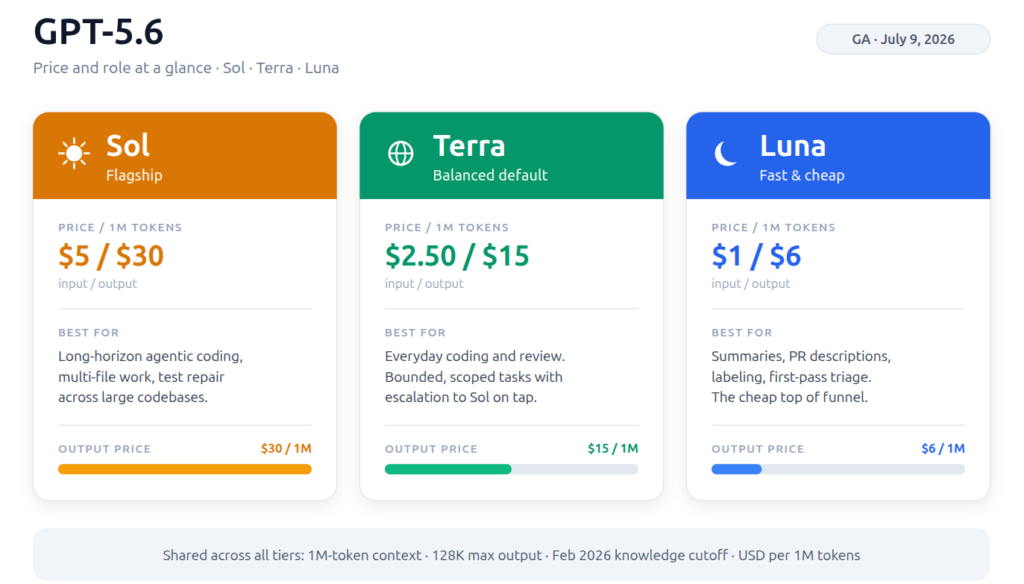
Three tiers, priced per million tokens:
All three share a 1M-token context window, 128K max output, and a February 2026 knowledge cutoff. Two new knobs matter: a max reasoning effort that lets Sol think longer, and an ultra mode that coordinates several subagents in parallel for complex work. The Responses API adds programmatic tool calling and more predictable prompt caching, with explicit cache breakpoints and a 30-minute minimum cache life. The models are already live in GitHub Copilot, though org admins have to switch them on. The policy ships off by default.
The agentic-coding story holds up. On CodeRabbit’s long-horizon run of 100+ tasks across five languages, Sol passed 63.7% versus Terra’s 40.7%, and did it using fewer output tokens than Terra. That is the interesting part: the cheaper tier burned more than twice the tokens per task. Cheaper per token does not mean cheaper per solved problem. Measure cost per resolution before you route volume to Terra.
Sol’s real character is follow-through. It reads the repo, writes the tests, handles edge cases like Unicode and zero-length slices, and grinds through the boring parts instead of running one happy-path test and calling it done. What it is not is the smartest model in the room. For open-ended architecture and taste, reviewers still reach for Claude Fable 5. Sol is who you want once the plan is already a checklist.
Now the skepticism. On SWE-Bench Pro, a widely watched coding eval, Sol lands around 64.6% while Claude Fable 5 and Mythos 5 sit near 80%. That is a real gap. Notably, OpenAI published a post right before launch arguing that roughly 30% of SWE-Bench Pro tasks are broken. Maybe they are right. The timing is also convenient. Read vendor benchmarks the way you would read a résumé.
The other cost is friction. GPT-5.6 shipped with OpenAI’s heaviest safety stack yet, including a government-coordinated preview and layered cyber and bio classifiers that inspect output as it is generated. OpenAI is upfront that this will sometimes block legitimate dual-use work such as vulnerability research, debugging, and security testing, and can add latency while a larger model reviews flagged output. If your work lives near security, expect the occasional false refusal.
If you are on GPT-5.5 and running coding agents, Sol is a clear upgrade for execution: long implementations, test repair, multi-file changes. Keep Terra for bounded tasks and Luna for the cheap top-of-funnel. Keep a second model around for architecture, because Sol will follow a bad plan as diligently as a good one. And run your own cost-per-task numbers. The token efficiency is the feature here. The leaderboard is just marketing.
