

A 5-part series — Part 2/5
We buried prompt engineering a little too fast. The discipline isn’t dead, it’s been demoted. It now sits at the innermost layer of the diagram from Part 1: how you phrase a request, inside a single call. That’s small. It’s also the first place everything can go wrong.
In this part I separate what actually works from what’s folklore. Because between 2022 and now, we piled up an impressive amount of superstition.
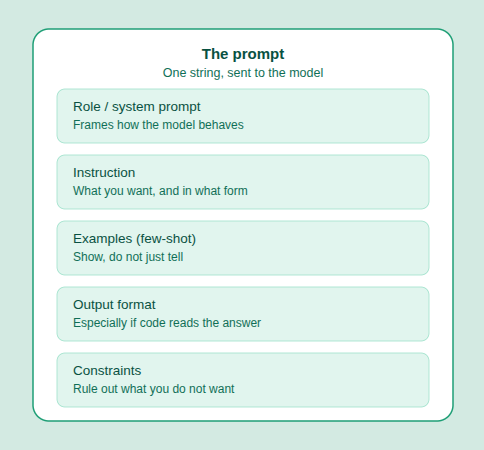
A prompt is the string of text you send the model. Nothing more. The job is to structure that string to maximize your odds of getting the right answer. A few components come up every time:
Schulhoff and his team’s Prompt Report catalogued 58 prompting techniques for text alone. That’s dizzying. The useful truth is that most of your gains come from a handful of them.
Three families hold up in 2026.
Examples. Showing beats explaining, and it stays the most reliable technique. Two or three well-chosen examples often beat a paragraph of instructions. If you want a specific tone, format, or classification logic, give concrete examples of it.
Explicit reasoning. Asking the model to think step by step (chain-of-thought) still improves logic and math tasks. Recent reasoning models internalize part of this work, but on a genuinely twisted problem, spelling out the steps still helps.
Structure. Clearly delimit sections with tags or separators, separate instructions from data, mark where the document starts and where the instruction ends. Anthropic, for instance, recommends XML tags for Claude. This isn’t cosmetic. A well-segmented prompt cuts down the model’s confusion about what to do and what to do it on.
Then there’s everything else. The magic phrases like “you are a world-class expert,” the tip promises, the “take a deep breath before answering.” Some had a measurable effect on older models under specific conditions. Most became small talk.
The deeper problem isn’t that these tricks are false. It’s that they create the illusion that a better prompt can fix anything. But a prompt can’t invent information the model doesn’t have. If your assistant answers badly because it doesn’t know your internal leave policy, no rephrasing will save it. It needs the policy in front of it. And at that point, you’ve already switched disciplines.
This is the pivot of the whole part. Prompt engineering hits one simple limit: it acts on phrasing, not on the content available.
The day you start pasting reference documents, database extracts, conversation history, or tool results into your prompt, you’re no longer doing prompt engineering. You’re managing context. You’re deciding what goes in the window, in what order, in what format, and what to take out. That’s a different job, with its own traps, and it’s the subject of Part 3.
If you kept only four habits:
That last point is the most neglected. You polish a prompt by eye, find it elegant, then discover in production that it fails one time in five. A small test bench beats every aesthetic opinion.
In Part 3, we open the window. Literally.
