

Three days ago I argued that the fix for long-context failure is to send the model less. That was right, and it was incomplete. It tells you to shrink the context. It does not tell you what to keep.
The default answer to that second question has been recursive summarization. Every few turns, compress the interaction history into a natural-language summary, carry the summary forward, discard the rest. It is the obvious move. It is what most agent harnesses do. And it comes with a tax that has been sitting there, unexplained, for as long as people have been building long-horizon agents: agents conditioned on recursive summaries underperform agents that keep the whole history [S1].
The usual reading of that tax is a ratio story. Compression loses information, lost information costs accuracy, so the lever is how hard you squeeze. Squeeze less and pay more for context; squeeze more and pay in capability. Pick your poison.
I think that reading is wrong, and a paper out of Berkeley has the measurements to say why.
The ABBEL work analysed belief states generated by frontier models across five domains, looking at where summary-conditioned agents actually lose ground. Two of the three findings are what you would expect: performance degrades when a summary omits information, and when it updates information incorrectly [S1].
The third is the interesting one. They also found settings where models “use memory inefficiently by retaining extraneous information” [S1].
Sit with that for a second. An agent that is wasting part of its budget on material it will never need is not an agent suffering from insufficient room. It has room. It is spending it badly. That is not a compression failure at any ratio — you could double the summary length and the same thing would happen, because nothing in the objective ever told the model what the summary was for.
This is the whole reframe. Recursive summarization asks a model to be brief. It never asks it to be sufficient. Brevity is measurable and gets optimised; sufficiency is neither specified nor rewarded, so it drifts. The summary is generated by the same model that will later depend on it, and at no point does anything check whether the second model can still do its job given what the first one wrote down.
The fix follows directly once the problem is stated that way. Make the summary an explicit belief state — the agent’s working memory, replacing the raw history — and then supervise its contents rather than its size.
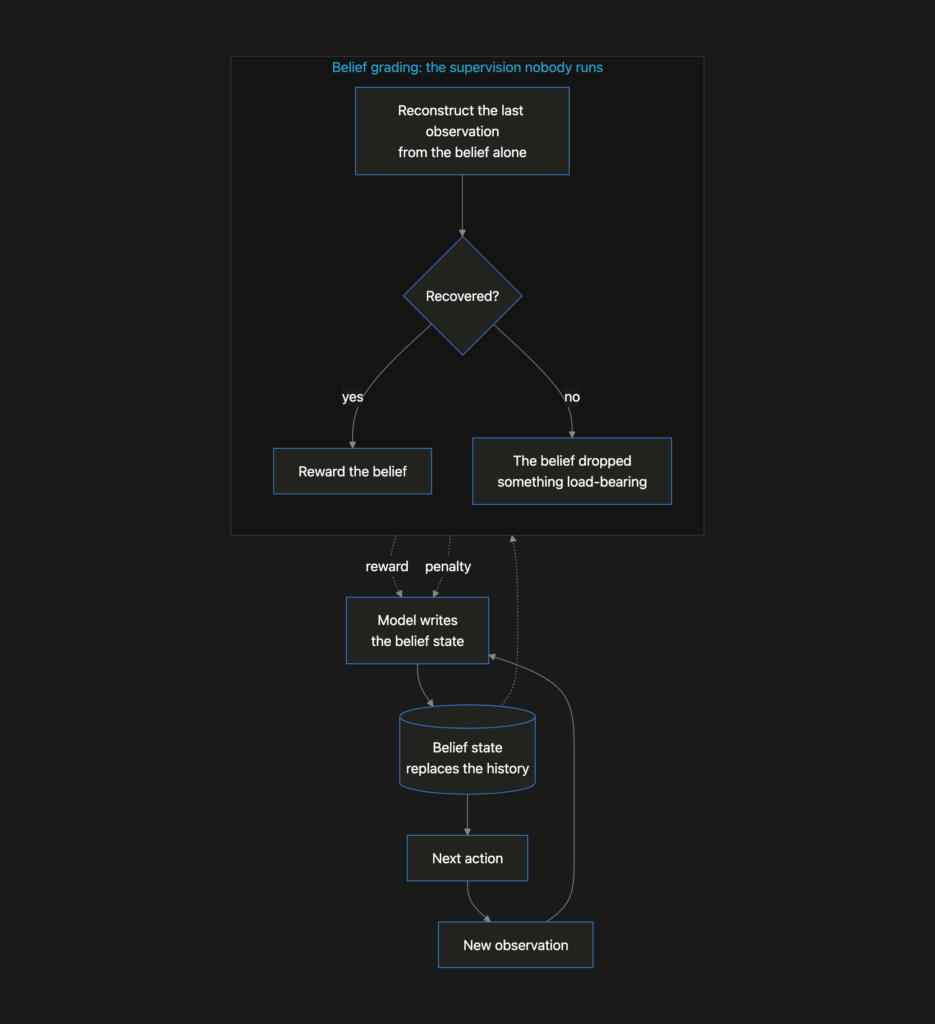
The supervision signal is the part worth understanding, because it is simpler than it sounds. A belief is graded by how well the current model can use it to reconstruct the most recent observation [S3]. If the belief carries what mattered, the model can regenerate what it just saw. If the belief dropped something load-bearing, it cannot. That is an autoencoding objective pointed at memory, and it turns “was this summary any good” from a judgement call into a reward.
Length is then handled as its own concern, by penalising the beliefs with the largest memory footprints, rather than being smuggled in as a proxy for quality [S1].
Belief grading: the supervision nobody runsyesnorewardpenaltyNew observationModel writes
the belief stateBelief state
replaces the historyNext actionReconstruct the last observation
from the belief aloneRecovered?Reward the beliefThe belief dropped
something load-bearing
The grading loop. The agent’s cycle runs on the belief alone; the supervision sits outside it, checking whether the belief still recovers what was just seen.
Two things are worth noticing about this design. The first is that it is not a better summarizer; it is a different supervision target for the same summarizer. The second is that it produces something you can inspect. A natural-language belief state is readable — you can open it mid-run and see what your agent currently thinks is true, which is more than can be said for most memory schemes.
The numbers are what move this from a nice reframe to something you should act on.
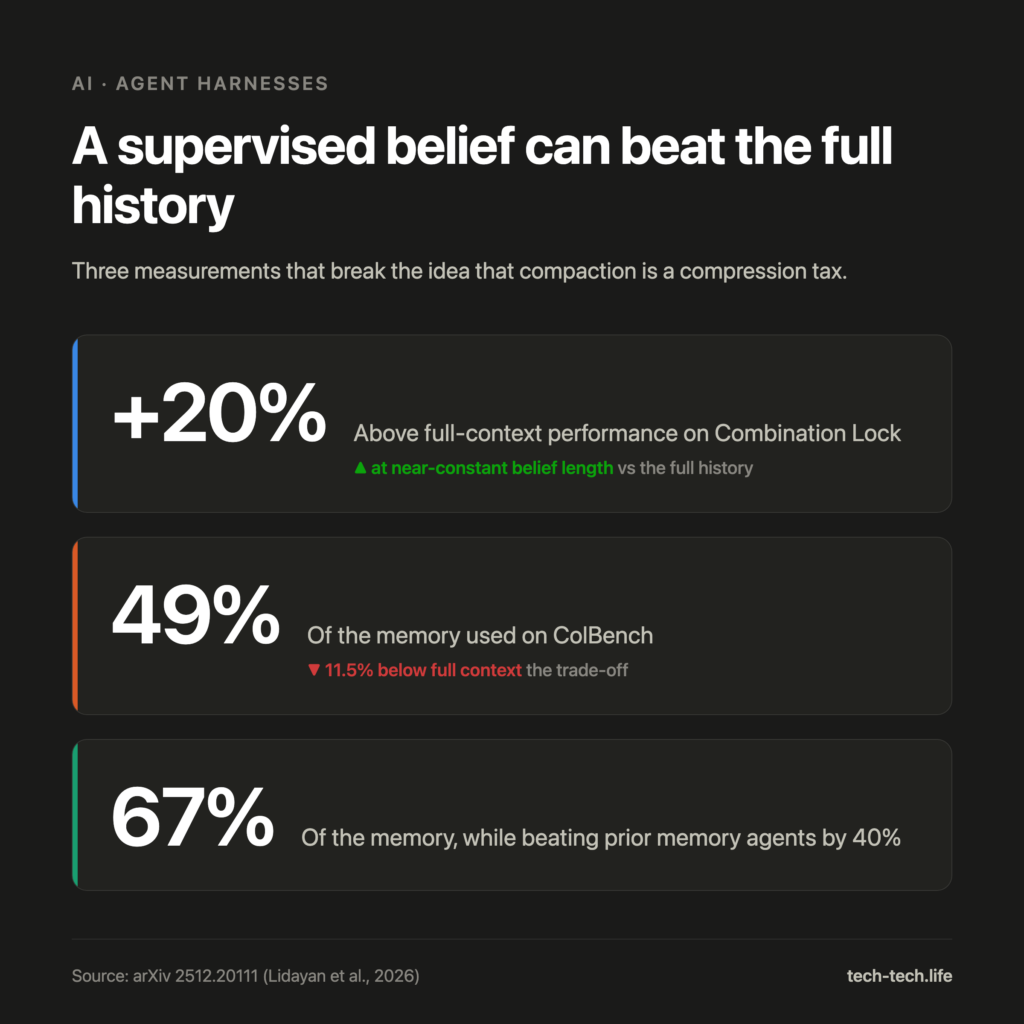
Against prior memory-agent work, ABBEL performs 40% better while using 67% of the memory [S1]. On ColBench, it lands 11.5% below the full-context baseline while using 49% of the memory [S2]. Those two are the ordinary result: most of the capability, roughly half the budget.
The one that matters is Combination Lock, where ABBEL exceeds full-context performance by about 20% while holding beliefs at near-constant length [S2]. And applied zero-shot to frontier models, “Gemini 2.5 Pro with ABBEL maintains or even exceeds the performance of both full-context settings in most tasks” [S2].
Exceeds. Not approaches. A well-supervised compressed memory beating the full history is not a result the ratio story can produce, because under that story the full history is the ceiling by definition. It is only surprising if you believed compaction was subtraction. Once you accept that the full history contains a great deal the agent does not need — and that attending to it has its own cost — a curated belief outperforming raw recall stops being strange and starts being obvious.
That is the same claim I made three days ago from the other direction. Capacity was never the constraint. Signal-to-noise was [S5].
I want to be careful here, because the frame is better than the mechanism.
The failure modes are still real and the authors name them: beliefs propagate erroneous information across steps, models hallucinate false memories of previous steps, and agents repeat uninformative actions “because the belief doesn’t change without new information” [S2]. The first is the dangerous one. An error inside a belief state is not a bad turn — it is a bad premise, and it persists until something contradicts it. Full-history agents get errors too, but a wrong observation sitting in a transcript is inert. A wrong belief is load-bearing.
So this is not a technique to reach for on Monday. It is a research result with a clear diagnosis, promising numbers, and known ways to go wrong.
What survives regardless of whether this specific method holds up is the diagnosis.
In July I described the harness — everything around the model that isn’t the model — and listed context management as one of its components. I framed it as a compression concern. That was the wrong noun. It is a supervision concern, and the difference is not academic: if compaction is compression, you tune it by adjusting a ratio and watching cost. If compaction is supervision, you tune it by measuring whether what survived is sufficient for the next decision, which is a different instrument entirely.
Almost nobody has that instrument. Go and look at your own agent’s compaction step. You will find a token budget and a prompt that says something like “summarise the conversation so far, preserving important details.” You will not find a measurement of whether the thing it produced was enough. The budget is enforced; the sufficiency is hoped for.
The measurement that would close it is not exotic, and that is the frustrating part. Take the summary your agent just wrote, hand it back to the same model without the transcript, and ask it to reconstruct the last thing it saw. If it cannot, your compaction step dropped something load-bearing — and you now know that it dropped something, which is precisely the fact you were missing before. One extra call, on a step you already run.
That gap is the whole story, and it has been hiding behind a word. Compaction sounds like a compression operation, so it got tuned like one — and the field spent two years optimising the ratio while the actual failure was that nothing ever checked what the summary had to survive.
Where a number could not be verified in a primary or independent source, it is marked as not published rather than estimated.
