

In 2026, the most talked-about engineering job in AI is the Forward Deployed Engineer, or FDE: a software engineer who leaves the comfort of the product team and goes to work inside a customer’s world until the thing actually runs.
The numbers are loud. Indeed data reported by Business Insider put FDE postings about 729% higher in April 2026 than a year earlier (LeadDev). OpenAI, Anthropic and AWS each put billions of dollars behind forward deployed teams in the space of two months. And yet, a recruiter quoted by the Wall Street Journal estimated that only about 10% of engineers actually want this job (The Pragmatic Engineer).
That gap between demand and appetite is exactly why I wanted to write this guide. I train developer teams on generative AI, and the question I hear most often after a session has moved from “which model should we use?” to “who is going to make this work in our systems?”. The FDE is the industry’s answer. This article walks you through what the role really is, what it pays, what it costs you personally, and how an engineer in Tunisia or anywhere in the MENA region can position for it.
A Forward Deployed Engineer is a software engineer employed by a vendor who works inside a customer’s organization, writes production code against the customer’s real systems and data, and is judged on a business outcome. The good versions of the role add one more duty: bring what you learned in the field back to the product team so the next deployment needs less custom work.
The model was born at Palantir. Its engineering blog explains the split between its two biggest engineering roles. “Devs” build the Foundry and Gotham platforms. “Deltas”, the Forward Deployed Software Engineers, sit in Business Development and deploy those platforms for one customer at a time. The name is a leftover from the early days, when each Business Development team was named after a NATO alphabet letter. Palantir sums it up in a formula worth memorizing: a Dev works on “one capability, many customers”, a Delta on “one customer, many capabilities” (Palantir Blog).
Two details from that origin story still matter today:
Palantir’s own Deltas insist they are not consultants. A consultant typically hands over an analysis or a recommendation. A Delta deploys existing software and stays until the customer can keep improving on its own. Keep that distinction in mind, because it is the single best test of whether a job posting with “FDE” in the title is the real thing.
For a decade the FDE was a Palantir curiosity. Generative AI changed that because it moved the hard part of enterprise software. Models are now sold by several labs with broadly similar capabilities. Wiring an agent into a company’s permissions, legacy systems, data and approval chains is where projects live or die.
An OpenAI FDE put it well at the Shift conference in September 2026: producing code has become cheap, and the real work is the system around it, the guardrails and constraints that let an agent behave reliably. He called the missing access to a company’s data, procedures and tools “the deployment gap” (Webfuse, citing ShiftMag). I agree with him, and I see it every week. A demo agent takes an afternoon. An agent that can safely touch a production record in a regulated company takes months of plumbing, security reviews and process redesign.
Investors saw it coming. In June 2025, a16z partner Joe Schmidt argued that AI application companies should accept lower gross margins in exchange for owning the customer’s workflow, and called the FDE the hottest job in startups (a16z). In 2026, the biggest players turned that thesis into money:
| Date | Who | What they announced |
|---|---|---|
| 30 Jun 2026 | AWS | A dedicated Forward Deployed Engineering organization backed by $1 billion, embedding engineers in customer teams (The New Stack) |
| 11 May 2026 | OpenAI | The OpenAI Deployment Company, with more than $4 billion from 19 investors and the acquisition of Tomoro, bringing about 150 FDEs on day one (Techzine) |
| 4 May 2026 | Anthropic | A standalone enterprise AI services firm with Blackstone, Hellman & Friedman and Goldman Sachs, aimed at mid-size companies (Fortune) |
| Nov 2025 | Salesforce | A stated target of around 1,000 FDEs to staff Agentforce deployments (FDE Pulse) |
One honest caveat before you get carried away by percentages: the growth starts from a tiny base. In January 2025 the title barely registered on job boards, so a 700% jump still means a small installed population compared with ordinary software engineering. That scarcity is good news for you if you have the profile, and a warning sign if a company uses the label loosely.
Forget the image of an engineer with headphones closing tickets. An FDE week swings between customer rooms and the editor. A Palantir Delta based in Abu Dhabi describes spending a couple of days a week on customer premises, split between stakeholder meetings and debugging, configuring and deploying the platform, then the rest of the week reviewing pull requests, planning solutions and talking to the internal product teams (Palantir Blog).
In the agent era, a typical engagement follows a loop like this one:
This loop is a synthesis published by Webfuse, and it matches what the vendors ask for in their postings. Anthropic’s Applied AI FDE listing, for example, asks engineers to deliver MCP servers, sub-agents and agent skills used in production workflows, to codify repeatable deployment patterns, and to travel 25 to 50% of the time to build in person with customers (Anthropic job listing). AWS works in pods of roughly five or six engineers per customer, on engagements of about 45 days (The State of AI).
My practitioner reading: steps 4 and 8 separate a real FDE from an expensive integrator. If nobody builds the eval set, nobody can prove the agent works. If nobody generalizes, the vendor is running a services shop with a product attached, and your career growth stalls with it.
The FDE overlaps with several older jobs, and some companies simply relabel them. The cleanest way to tell them apart is to ask four questions: when do you engage, do you own production code, do you own an outcome, and does your work change the product?
| Role | When they engage | Owns production code? | Owns an outcome? | Feeds the product roadmap? |
|---|---|---|---|---|
| Forward Deployed Engineer | After the contract, for weeks to months | Yes | Yes, a business result | Yes, by design |
| Product software engineer | Continuously, inside the vendor | Yes, the platform | A product area | It is the roadmap |
| Sales or solutions engineer | Before the sale | Rarely, demos and proofs of concept | The technical win | Informally |
| Solutions architect | Before and after the sale | Rarely, designs more than codes | Partly | Sometimes |
| Consultant or integrator | Per scoped project | Often, custom code | Project delivery | Usually not |
Adapted from Webfuse and Palantir. The Pragmatic Engineer gives a concrete example from OpenAI: its solutions architects tend to build MVPs offline with anonymized data, while its FDEs write code directly on customer infrastructure.
The title is also fragmenting. Rung’s August 2026 census of 368 open roles found the same job posted under four families: Forward Deployed Engineer, Deployment Strategist, Forward Deployed Software Engineer and AI or Deployment Engineer (Rung). Other variants you will meet include Applied AI Engineer and Forward Deployed AI Engineer. If you search only one title, you will miss a large part of the market.
The FDE profile is broad rather than deep, but the interviews still test depth. Rung’s analysis of 285 full job descriptions gives a useful map of what employers ask for (Rung):
| What the posting emphasizes | Share of postings |
|---|---|
| Customer or client facing work | 99% |
| Python | 76% |
| Travel or on-site work | 76% |
| APIs and integrations | 64% |
| Cloud (AWS, GCP, Azure) | 64% |
| JavaScript, React, TypeScript | 59% |
| Data, SQL, pipelines | 52% |
| US security clearance | 31% |
| LLMs and generative AI | 30% |
| Kubernetes, Docker, IaC | 13% |
I group what you need into three layers.
1. Production engineering. You must be able to ship, alone, against someone else’s systems. That means backend services and APIs, SQL and data pipelines, one major cloud, authentication (SSO, OAuth, RBAC), and enough DevOps to deploy what you build. Every FDE interview loop Rung looked at still includes live coding and SQL under time pressure.
2. Agent and LLM engineering. For AI-lab and agent-startup roles: tool calling, MCP servers, retrieval, context engineering, evaluation sets, tracing and cost-per-task thinking. Anthropic’s postings explicitly mention MCP servers, sub-agents and agent skills as deliverables. This layer is still rare, which is why it pays.
3. Field skills. Palantir’s Deltas name “technical decomposition” first: taking a vague business problem and breaking it down to the lines of code that solve it. Add requirements discovery, writing clearly for executives, saying no to scope creep, and knowing when to build something custom versus pushing it into the core product. Palantir’s CTO Shyam Sankar has described the ideal candidate as someone ready for a last-minute flight, able to ship quality code the same day, and with enough emotional intelligence to talk to users (Webfuse, citing The Register).
What you do not need, in most cases: a sales quota. Bloomberry’s review of 1,000 postings found that none of them were quota-carrying (Nexus IT Group).
The employers fall into three groups. First, the pioneer and the data platforms: in Rung’s August 2026 census, Palantir (105 openings), Databricks (94) and Salesforce (83) held 282 of 368 open roles. Second, the AI labs and their deployment arms: OpenAI, Anthropic, Cohere, Mistral, Scale AI. Third, a long tail of agent startups and SaaS companies hiring their “first FDE”. Consultancies are joining too: Deloitte has posted a listing for an “Anthropic Forward Deployed Engineer” (AI+ Founders Community).
The pay is senior-engineer pay, sometimes more. All figures below are posted bands or self-reported data, mostly from the US:
| Benchmark | Figure | Source |
|---|---|---|
| US median total compensation, FDE title | about $216K (25th to 75th percentile: $179K to $290K), Oct 2026 | Levels.fyi via Webfuse |
| Median disclosed US band, 21 postings | $198K to $294K, up to $400K plus equity | Rung |
| Anthropic FDE, Applied AI (US base) | $200K to $300K | Anthropic listing |
| Anthropic FDE, London | GBP 225K to 255K | Anthropic listing |
| Industry median base, 1,000 postings | $173,816 | Paraform |
Do not copy these numbers into a negotiation in Tunis, Casablanca or Dubai. They describe US and UK markets. What transfers is the ratio: wherever the role exists, it tends to sit at or above the senior software engineer band, because the profile is scarce.
The interview loop tests fundamentals the job description never spells out. Expect three blocks: live coding, a SQL or data exercise, and an open-ended customer case where you scope a messy problem out loud (Rung). Some companies have streamlined this; Google Cloud reportedly runs a two-interview process for FDEs (daily.dev summary of The Pragmatic Engineer). Prepare the customer case like a system design interview with a human twist: ask about users, constraints and success metrics before you touch architecture.
The FDE seat is rarely a final destination. Because you touch code, customers, product and business strategy at once, a few years in the field open more doors than most engineering roles.
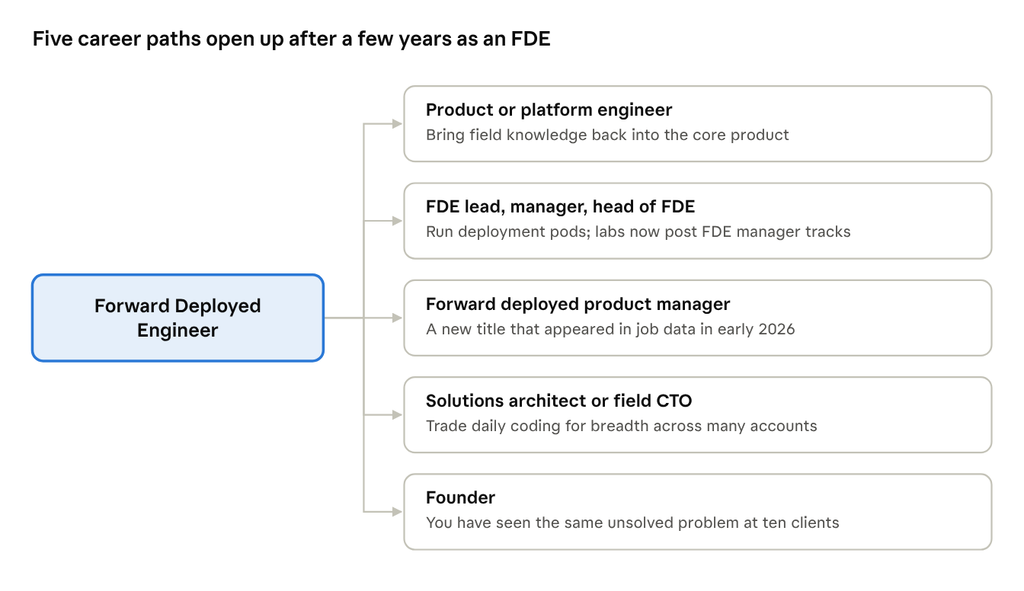
career paths after FDE · 5 options
The moves are well documented. Palantir says there is a lot of movement between its Delta and Dev roles, and some of its engineers have gone from field work to pure product development (Palantir Blog). A Forward Deployed Product Manager title first appeared in US job data in early 2026 (Dexity). And the founder path is real: the CEO of Hex, Barry McCardel, is a former Palantir forward deployed engineer (a16z). Seeing the same unsolved problem at ten clients is the best startup idea generator I know.
A guide that only sells the role would do you a disservice. Here is what makes engineers walk away.
My take: none of these is a reason to avoid the track. They are reasons to choose your employer carefully. Before you sign, ask three questions. What did the last FDE contribute back to the product? What share of my time is engineering versus meetings and pre-sales? Who owns the customer relationship, me or an account executive? Vague answers are your answer.
Most FDE content is written from San Francisco. Let me write from Tunis. The role is more reachable for us than the headlines suggest, for three reasons.
The jobs are already near us. In 2026, FDE roles appeared in Dubai, Abu Dhabi, Riyadh and Doha, from companies such as Salesforce, Cohere, ElevenLabs, Microsoft and Scale AI (Indeed UAE, FDE Interviews). Paris is a hub: Mistral, OpenAI, Anthropic, Databricks and Notion all list forward deployed roles there (FDE Times). Trackers even show a forward deployed software engineer listing covering Rabat and Paris (Forward Deployed). Rung estimates that about 19% of roles are remote-friendly, so a slice of the market is open without relocating.
Our languages show up as hiring criteria. Anthropic’s Paris FDE role asks for fluent French and English. Salesforce posts FDE roles in Dubai specifically for Arabic speakers, and several Riyadh and Abu Dhabi listings ask for Arabic too (Beeps Digital). An engineer who can run a workshop in Arabic in the morning, write a design doc in French at noon and argue with a US product team in English in the evening is exactly the profile these companies struggle to find.
Our industry already trained us for the messy part. Many Tunisian engineers grew up in ESNs and offshore delivery centers, integrating systems for European clients under tight deadlines. That is forward deployed work without the title. The missing pieces are usually product ownership, outcome thinking and modern agent engineering, and all three can be learned.
Where I would aim, in order of reachability:
One caution: do not market yourself as “cheap offshore FDE”. The whole point of the role is trust and proximity. Sell your languages, your time zone overlap with Europe and the Gulf, and the production systems you have shipped.
If you are a developer with three or more years of experience, this is the plan I would follow. Tick the boxes as you go.
Days 1 to 30: close the production gaps.
Days 31 to 60: build one deployment-grade agent.
Days 61 to 90: prove the field skills and go to market.
The portfolio project matters more than any certificate. An FDE hiring manager wants evidence that you can walk into an unfamiliar system and leave behind something that runs without you.
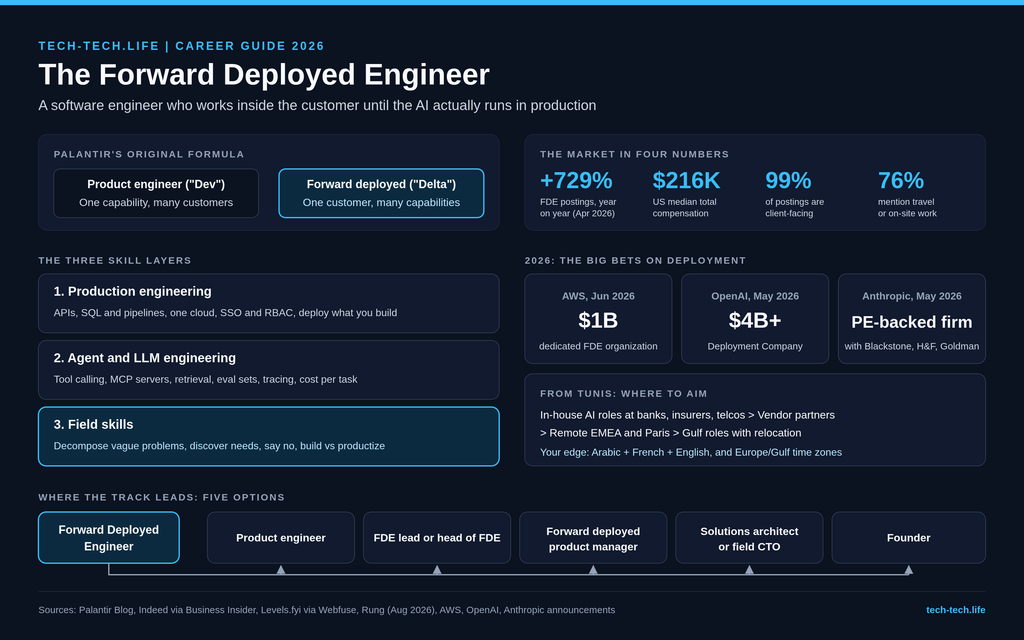
The Forward Deployed Engineer is what happens when writing code gets cheap and understanding a business stays expensive. The labs, the clouds and the investors have all made the same bet in 2026: the winner in enterprise AI is whoever can make agents work inside real organizations, and that takes engineers who are comfortable in the customer’s meeting room and in the customer’s codebase.
Is it for you? If you enjoy users as much as you enjoy code, if ambiguity energizes you instead of draining you, and if you can live with a suitcase near the door, the FDE track is one of the best career bets an engineer can make right now. If you love deep, quiet product work, stay where you are and become the engineer who builds what FDEs deploy. Both paths need each other.
Tell me in the comments: would you take an FDE role, and what would make you say no?
