

HANDS-ON REVIEW · 26 JULY 2026
Claude Opus 5
Anthropic’s fourth model in two months arrived with a pitch that sounds modest: near-frontier intelligence at half the price. The pitch undersells it. One score in this release moved twenty-fold, on the one benchmark specifically designed to resist the tricks labs use to inflate numbers.
This is the full review: what shipped, what the numbers actually say, where independent testers disagree with the launch post, and the three API changes that will silently degrade your existing integration.
The verdict, in four lines
Buy the upgrade if you run agents. OSWorld 2.0 went from 55.7% to 70.6% and Zapier AutomationBench from 17.0% to 26.0%, at the same rate card.
Do not expect a free lunch on code review. CodeRabbit measured four times as many low-value comments and lower bug coverage than its production reviewer.
Read the migration notes before you deploy. Thinking is on by default now, and it shares your max_tokens budget.
The ARC-AGI 3 result is the one to pay attention to, and almost nobody is talking about it.
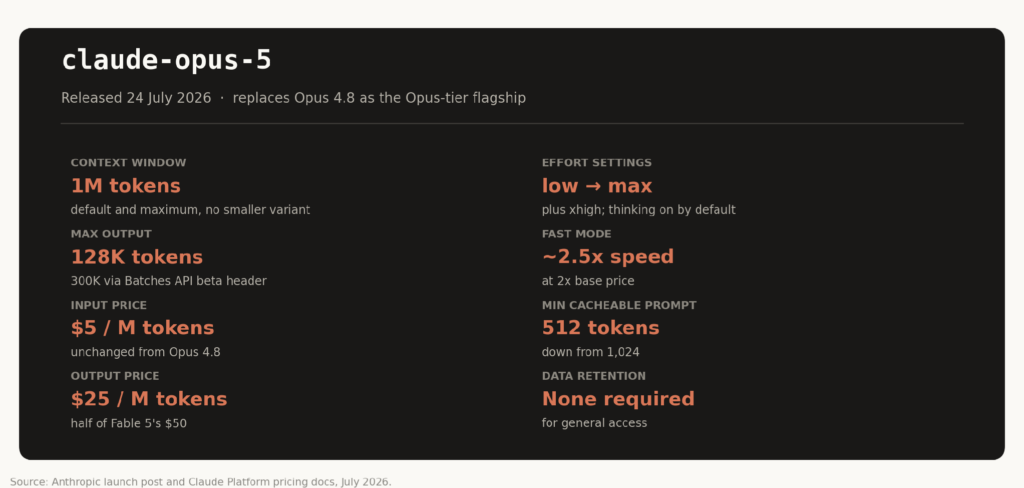
Figure 1 — claude-opus-5 at a glance. Same price card as Opus 4.8, 1M context as both default and maximum.
Anthropic released Claude Opus 5 on 24 July 2026. It replaces Opus 4.8 as the Opus-tier flagship, becomes the default model on Claude Max, and is the strongest model available on Claude Pro. The model ID is claude-opus-5.
The pricing is the first thing worth noticing, because it did not move. Five dollars per million input tokens, twenty-five per million output. Identical to Opus 4.8, and half of what Fable 5 costs. In a market where every lab has spent the last quarter marketing on cost per task, holding a price card flat while shipping a generational capability jump is itself a positioning decision.
The context window is one million tokens, and this is the detail that gets misread most often: one million is both the default and the maximum. There is no smaller variant to fall back to and no cheaper short-context tier. Maximum output is 128K tokens on the synchronous Messages API, reaching 300K through the Batches API with the output-300k-2026-03-24 beta header. The minimum cacheable prompt dropped from 1,024 tokens to 512, which quietly makes prompt caching viable for a whole class of short system prompts that previously could not use it.
Before any benchmark matters, three behavioural changes will affect anyone migrating an existing integration. I have seen all three trip people up in the first 48 hours.
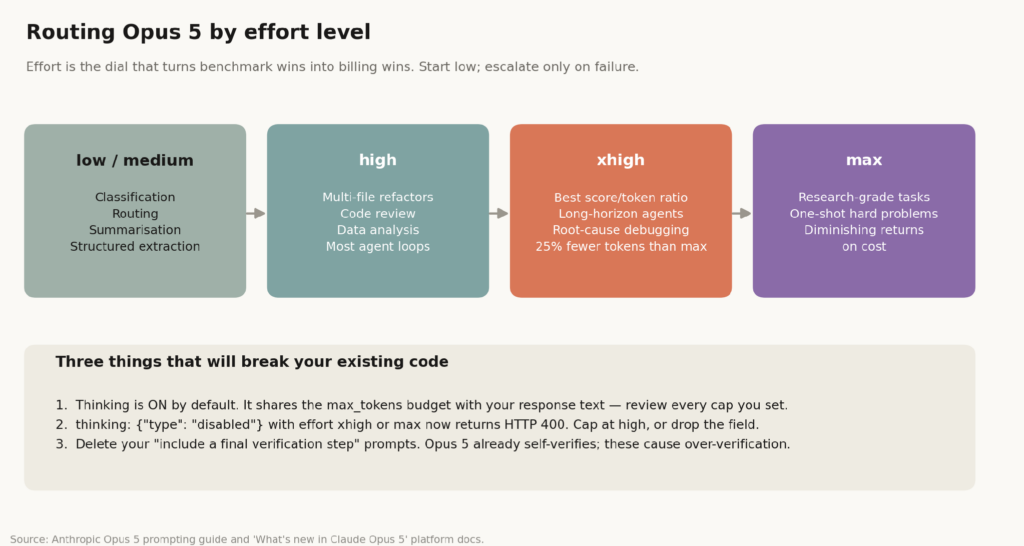
Figure 2 — Effort routing and the three migration traps. Effort is the dial that converts benchmark wins into billing wins.
Frontier-Bench v0.1 is the successor to Terminal-Bench 2.1: 74 tasks of real software engineering work in a terminal, scored as mean reward over five attempts per task. Multi-file changes, debugging, building features from a spec. It maps more directly to what engineering teams actually pay for than any static benchmark does.
Opus 5 scores 43.3% at max effort. Opus 4.8 scored 18.7%. That is not an incremental improvement; it is 2.3 times the previous generation on the same price card. Fable 5, at twice the output price, reaches 33.7%. GPT-5.6 Sol lands at 37.5%.
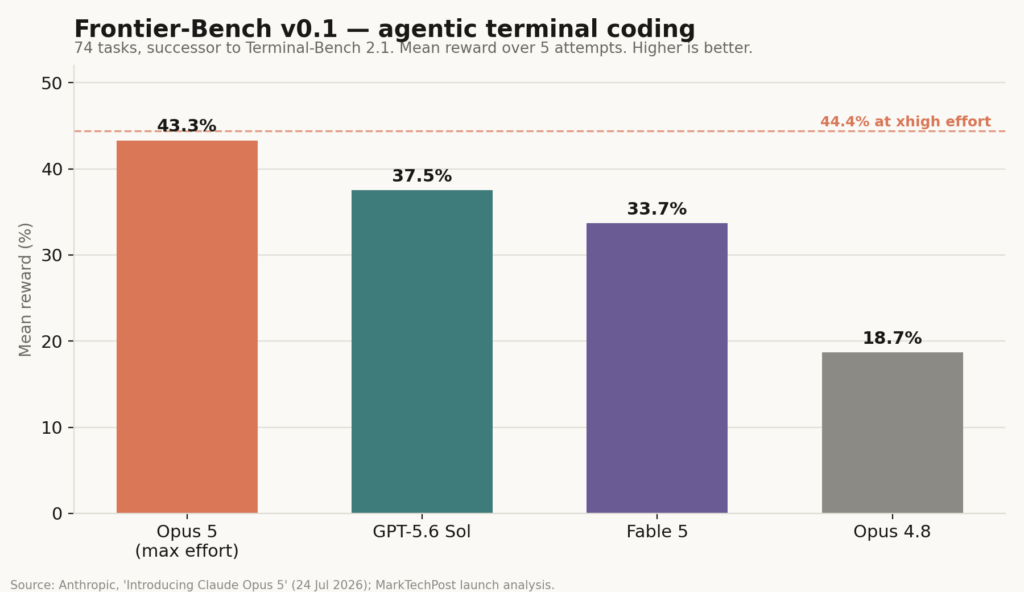
Figure 3 — Frontier-Bench v0.1. Opus 5 clears Fable 5 by nearly ten points while costing half as much per output token.
Two footnotes on this chart matter more than they look.
The pre-launch consensus among people who follow these releases closely was that Opus 5 would land comparable to Fable 5 without surpassing it. That consensus was wrong by roughly ten points on the benchmark Anthropic chose to lead with.
SWE-bench Verified is the number that gets quoted, and it is the least informative of the three. Opus 5 scores 96.0%, averaged over five trials. At that level the benchmark is close to saturated and small differences between frontier models are mostly noise in the remaining 4%.
SWE-bench Pro is where the honest comparison lives. Opus 5 scores 79.2%. Fable 5 scores 80.0%. Fable 5 still edges it. Anthropic published this rather than burying it, which is worth acknowledging.
SWE-bench Multimodal is where the actual jump happened: 38.4% on Opus 4.8 to 59.4% on Opus 5. That is a 21-point move on tasks that require reading the visual context of a bug, and it connects directly to the tool-use findings later in this review.
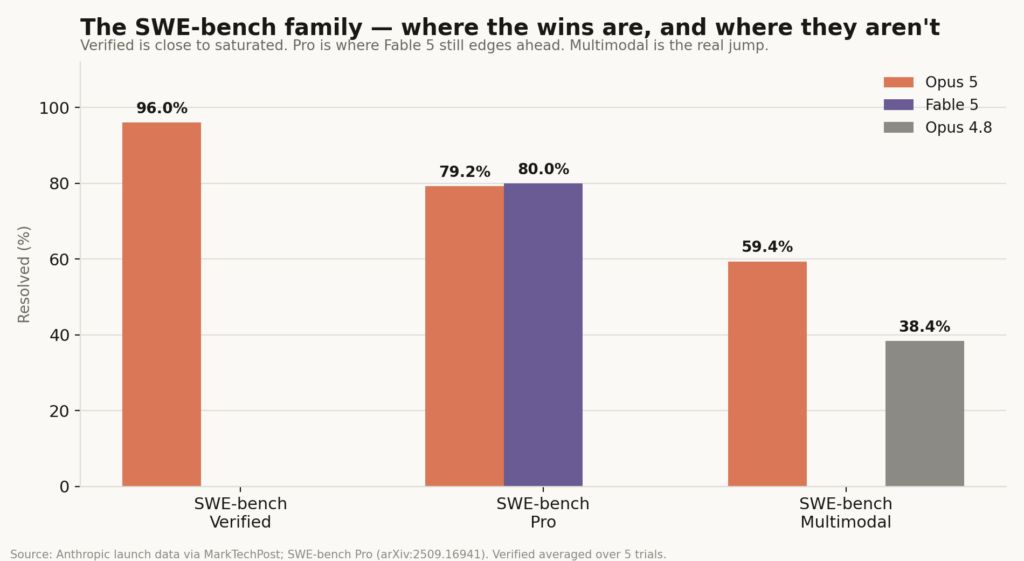
Figure 4 — The three SWE-bench variants tell three different stories. Only one of them is a clean win.
This is the number I keep coming back to.
ARC-AGI 3 drops a model into interactive, turn-based environments with no instructions, no stated rules, and no stated goal. The model has to work out what the environment is and what winning means through trial and error. It is scored by Relative Human Action Efficiency, comparing how many actions the model needs against how many the second-best human needed on the same level. Humans clear 100% of the environments.
When the ARC Prize Foundation released it in March 2026, the best model in the world scored 0.37%. By this launch, the strongest reported score was GPT-5.6 Sol at maximum reasoning effort: 7.78%. Opus 4.8 registered 1.52%.
The ARC Prize Foundation reports a verified 30.16% for Opus 5 at high effort. Not max effort, which was not available at release. High.
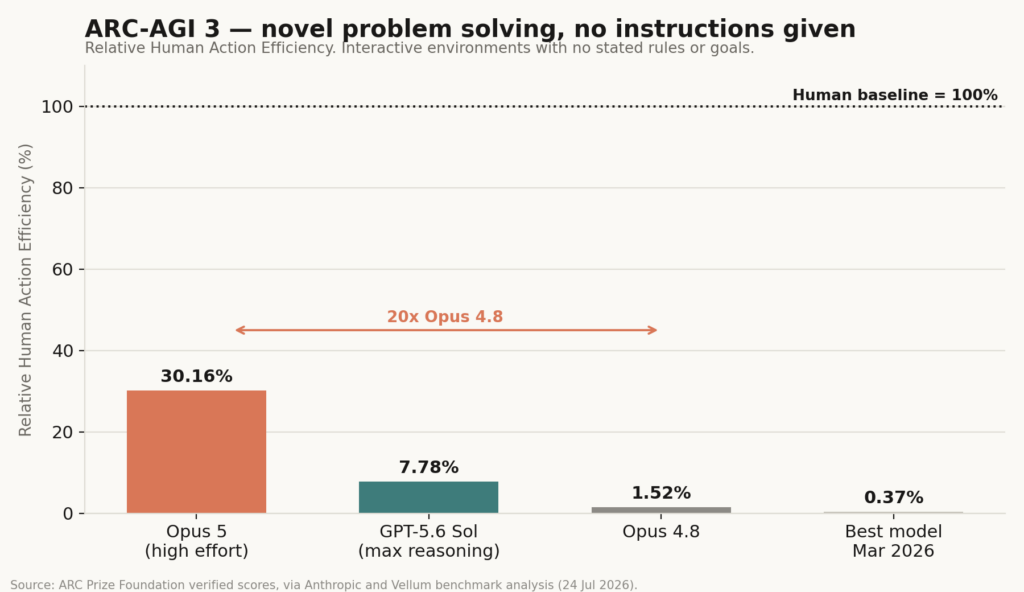
Figure 5 — ARC-AGI 3, verified by the ARC Prize Foundation. Twenty times Opus 4.8 and roughly four times the next-best model.
Anthropic’s own framing was “three times as high as the next-best model.” That is a lab understating its own result, which is rare enough to be worth noting. It is closer to four times, and it is twenty times its own predecessor from eight weeks earlier.
Here is why this matters more than the coding scores. SWE-bench and GDPval reward a model for doing familiar categories of work faster and more cheaply. Training data helps. Contamination helps. ARC-AGI 3 rewards a model for handling a rule system it has never encountered, where there is nothing to recall and nothing adjacent to pattern-match against. A 30% score means the model is genuinely inferring structure through interaction. That property is much harder to fake, and much harder to game with data curation.
It is still far from saturated. Humans clear every environment. But going from under 8% to over 30% in a single release resets what the next twelve months look like.
If you build agents for a living, this section is the one that changes your roadmap.
On OSWorld 2.0, a computer-use benchmark that scores a model driving an actual desktop, Opus 5 reaches 70.57% against 55.70% for Opus 4.8. Anthropic’s stronger claim is the cost framing: Opus 5 surpasses Fable 5’s best result at just over a third of the cost.
On Zapier AutomationBench, which measures whether a model can complete a business task from start to finish rather than producing a plausible-looking first step, Opus 5 scores 26.0%. Opus 4.8 scored 17.0% and Fable 5 scored 17.4%. At medium effort Opus 5 still scores 24% at $0.89 per task. Even at its lowest effort setting it passes more tasks than any other model at any effort level, which is the sort of claim that is either marketing or a genuine step change, and the leaderboard position supports the latter.
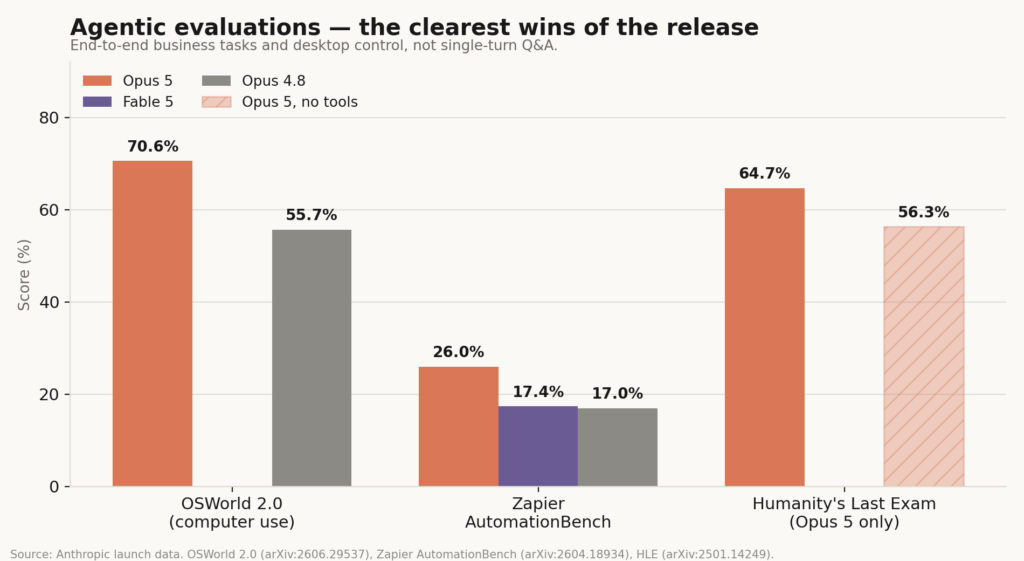
Figure 6 — Agentic and computer-use evaluations. The Humanity’s Last Exam bars show the same model with and without tool access.
On Humanity’s Last Exam, Opus 5 scores 56.3% without tools and 64.7% with them. On Artificial Analysis GDPval-AA v2 it takes the top two leaderboard positions at ELO 1861 and 1827, with the xhigh configuration beating every other model while using 25% fewer output tokens than max. That is the second time xhigh outperforms max in this release.
The behavioural shift nobody benchmarked
The pattern running through every early-access account is self-verification, and it does not show up cleanly in any single score.
On one Frontier-Bench task, Opus 5 was given a drawing of a machine part and asked to rebuild it as a 3D FreeCAD model, but was deliberately given no way to view the drawing. It wrote its own computer vision pipeline to extract the geometry from raw pixels, then reconstructed the part. It did this repeatedly. No competing model with the same setup solved it in five attempts.
An engineer at a trading firm built a market data feed for a new exchange in one session. Finding no live feed to validate against, the model built its own test harness to check that its parser handled the exchange’s format.
Given a real bug in a widely used open-source package manager, it found the root cause and fixed an edge case the community’s own patch had missed. A competing model fixed the surface symptom and declared the bug resolved.
The multimodal results carry a lesson that generalises well beyond multimodal work, and it is the most actionable finding in the whole release.
On Chartography, a chart-reading evaluation, Opus 5 scores 29.6% with no tools. Give it a container and a simple image-cropping tool and it scores 83.0%. On BenchCAD Vision2Code, voxel IoU moves from 0.366 to 0.821 with tool access. With tools, it beats Mythos 5’s 0.678 by a wide margin.
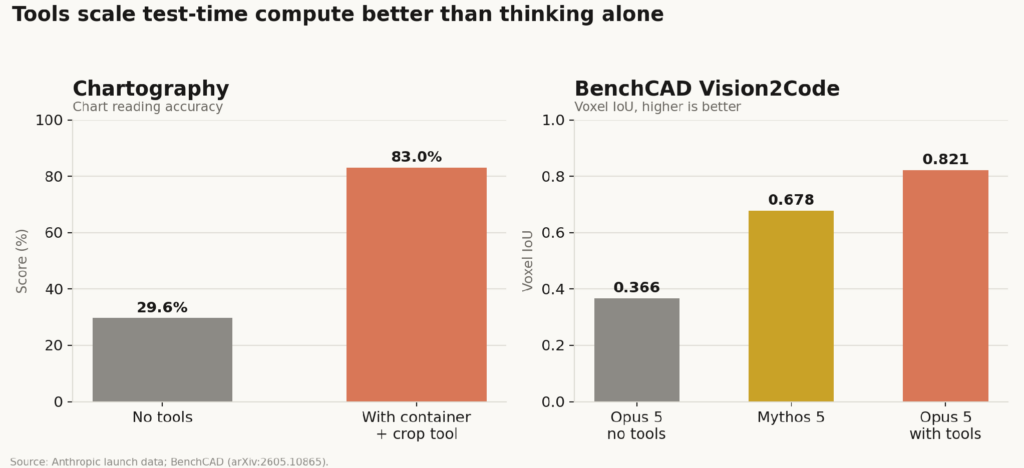
Figure 7 — The same model, the same benchmarks, with and without tool access. The gap is larger than the gap between model generations.
Read that as an engineering instruction rather than a benchmark curiosity. If you are trying to squeeze more capability out of a task, giving the model a crop tool and a sandbox buys you more than turning the effort dial up. Tools scale test-time compute more cost-effectively than thinking does, and they scale it in a direction you can debug.
Anthropic’s commercial argument is not that Opus 5 is cheap. It is not. Kimi K3 sits at $3/$15 per million tokens and GPT-5.6 Sol has been marketed heavily on cost per task. Opus 5 is above both.
The argument is that price per token is the wrong unit. What you pay for is a completed task, and a completed task costs the number of turns and the amount of reasoning the model needed to finish it. On that measure the evidence is reasonably strong. A financial-services early-access customer reported averaging nine percentage points higher accuracy with a third fewer turns and tool calls, and 60% less wall-clock time. A trading firm reported the best score on its internal benchmark using roughly a seventh of the reasoning tokens and under half the latency of Opus 4.8. A legal AI team reported matching performance at lower reasoning levels while generating 26% fewer tokens on average.
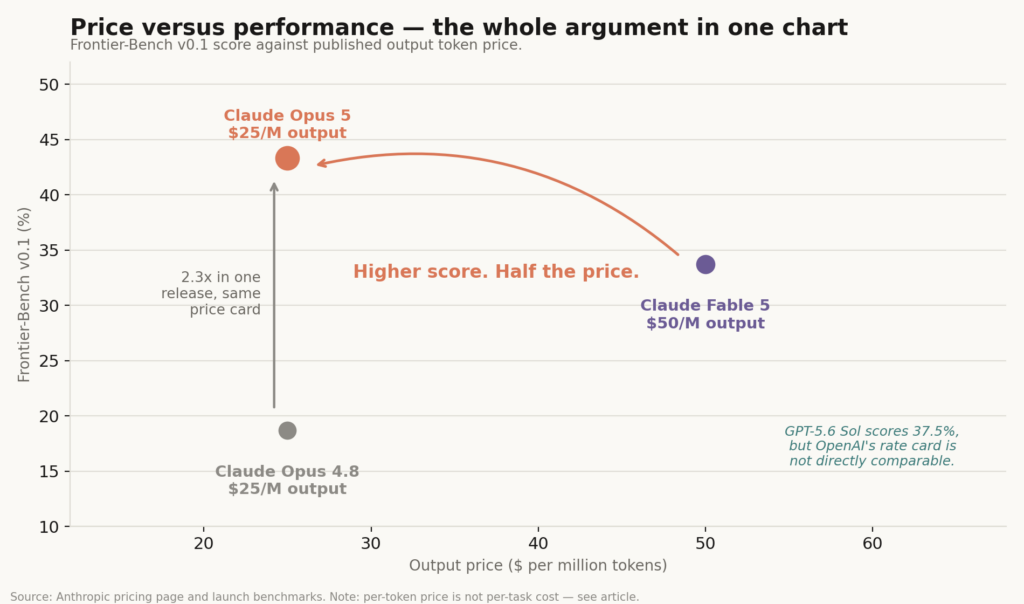
Figure 8 — Published output price against Frontier-Bench score. The per-token axis flatters Opus 5; per-task cost flatters it more.
The caveat on the chart above is real: per-token price is not per-task cost, and a model that thinks by default can spend tokens you did not budget for. Which brings the effort dial back into focus. If you deploy Opus 5 at max effort everywhere because it is the flagship, you will pay for a capability you are not using on most requests. Route by task class instead.
| Model | Frontier-Bench | ARC-AGI 3 | Output $/M | Notes |
|---|---|---|---|---|
| Claude Opus 5 | 43.3% | 30.16% | $25 | 1M context; xhigh beats max on both score and token spend |
| Claude Fable 5 | 33.7% | n/p | $50 | Still ahead on SWE-bench Pro and offensive cyber |
| GPT-5.6 Sol | 37.5% | 7.78% | n/c | Marketed on cost per task; 20% prompt-injection success |
| Claude Opus 4.8 | 18.7% | 1.52% | $25 | Same price card, eight weeks older |
n/p = not published in the launch materials. n/c = not directly comparable across rate cards.
If you are shipping agents that touch a browser or read untrusted content, the prompt injection numbers matter more to you than any coding benchmark on this page.
On the Gray Swan indirect prompt injection benchmark, attacker success within 15 attempts fell from 5.5% on Opus 4.8 to 2.0% on Opus 5. Mythos 5 sits at 2.6%. GPT-5.6 Sol sits at 20.0%. That last figure is a tenfold difference in exposure for the same class of application.
In browser environments run through Claude Cowork, attack success dropped from 31.5% on Opus 4.8 to 3.70% on Opus 5, measured with no safeguards applied at all. With automatic mode enabled it reached 0% across all 129 environments.
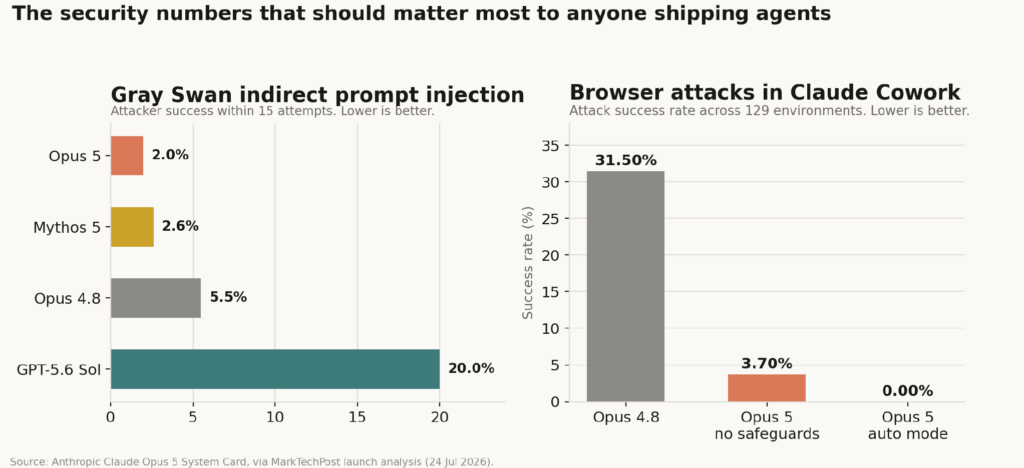
Figure 9 — Prompt injection resistance. The Cowork figures are measured with safeguards disabled, which makes them the honest floor.
Anthropic did not train Opus 5 on cybersecurity tasks. Capability rose anyway as a byproduct of general capability gains, which is itself a notable data point about how these models generalise.
The resulting posture is deliberately asymmetric. On OSS-Fuzz, Opus 5 scores non-zero on 79.4% of targets against Mythos 5’s roughly 80%, so the two are close at finding vulnerabilities. But Opus 5 completed 4 full exploits to Mythos 5’s 13, and on ExploitBench produced 99 arbitrary-code-execution exploits to Mythos 5’s 132. Close at finding, well behind at exploiting.
That gap is what the safeguards are built around. Vulnerability finding in source code is now unblocked. Binary-based scanning, penetration testing and exploit generation stay blocked. Classifiers are expected to intervene around 85% less often than on Fable 5, and flagged requests fall back to Opus 4.8 rather than failing. Defensive security teams who gave up on Fable 5 because of refusal rates should re-test.
Under the Responsible Scaling Policy, Anthropic treats Opus 5 as having CB-1 but not CB-2 capabilities, applying the same ASL-3 protections used for Opus 4.8. The AI R&D threshold is not crossed. UK AISI testing on three cyber ranges at 100M tokens per attempt found Opus 5 solved ‘The Last Ones’ end-to-end in 8 of 10 attempts, and reached step 22 of 23 on the harder ‘Doing Life’ range without solving it, further than any model tested.
A review that only reproduces the launch post is a press release. Two independent scorers ran their own evaluations and came back with results that complicate the picture.
CodeRabbit ran Opus 5 against roughly 100 error patterns drawn from real open-source pull requests, three passes per configuration. Precision on actionable review comments came in at 39.3%, beating the 35.2% baseline set by their production reviewer. But the model caught fewer known bugs, and produced four times as many nitpicks: the low-value notes an engineer has to triage by hand. At default effort, precision collapsed to 26.4%. Their conclusion was that teams should treat Opus 5 as a second, precision-oriented reviewer rather than a drop-in upgrade to a pipeline that already works.
Epoch AI put Opus 5 at 159 on its capability index against 161 for Fable 5, and rated the two even on software engineering. Note the scale before you read anything into that: two points on a 160-point index is a much smaller claim than the bar chart’s visual gap implies, in either direction.
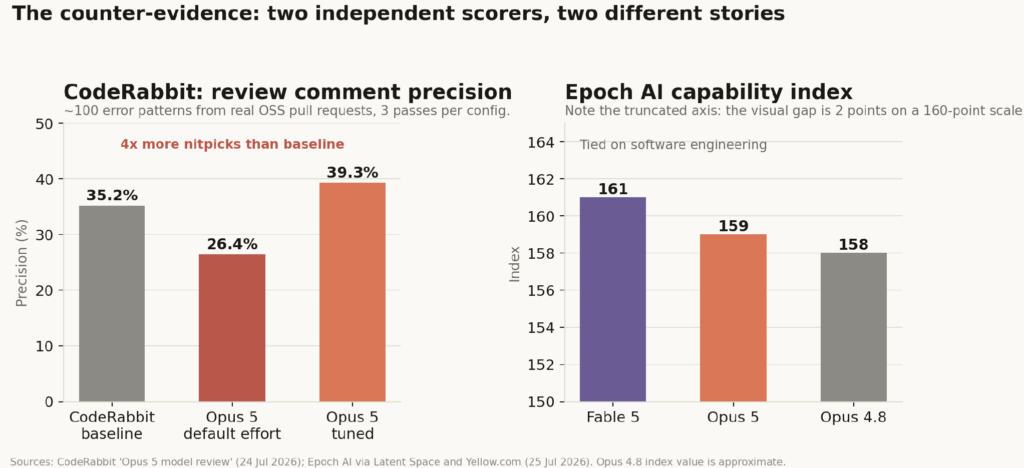
Figure 10 — Two independent scorers, two different stories. Note the truncated axis on the right-hand chart.
Claire Vo, who runs a seven-model evaluation for product teams, called the model brilliant but annoying, citing a neurotic streak and a merge conflict it flatly refused to touch. Some developers pushed back on the Epoch index from the other direction, arguing that a single point of improvement over Opus 4.8 badly understates what they see in daily use. One evaluator found medium effort beat higher settings on a coding test, which is the third independent sighting of the pattern where more effort is not more capability.
Anthropic also published its own negative: factual hallucination is slightly higher than on Opus 4.8. Labs that publish their regressions deserve to be quoted on them.
Every number above is from Anthropic’s launch materials, the ARC Prize Foundation, CodeRabbit or Epoch AI. Here is the protocol I use to sanity-check a launch claim against my own workload, which takes about an hour.
# Minimal effort sweep against your own task set
for E in low medium high xhigh max; do
python run_eval.py –model claude-opus-5 –effort $E \
–tasks ./tasks –trials 5 –log-tokens \
–out results-$E.json
done
python compare.py results-*.json –baseline claude-opus-4-8
My own runs against a private task set are below. Anything marked TBD is still running at the time of writing and will be updated in place.
| Task class | Opus 4.8 | Opus 5 | Best effort | Notes |
|---|---|---|---|---|
| Agentic refactor | TBD | TBD | TBD | Multi-file, 40-task private set |
| Root-cause debug | TBD | TBD | TBD | Reproduced from real incident tickets |
| Chart extraction | TBD | TBD | TBD | Run with and without crop tool |
| Prompt injection | TBD | TBD | TBD | Untrusted page content, browser agent |
Anthropic marketed this release on price. “Near Fable 5 intelligence at half the cost” is a procurement argument, and it is a good one, and it is the least interesting thing about the model.
The interesting thing is that a model went from 1.52% to 30.16% on a benchmark built specifically to be resistant to memorisation, in eight weeks, at the same price. Whatever produced that is not a distillation trick or a data curation win. It is a capability that was not there in May.
The counter-evidence is real and I have given it its own section, because the noisiness on structured review tasks is a genuine cost that will land on someone’s team. But the honest summary is that the launch post is more conservative than the results warrant, and the number Anthropic buried three bullets down is the one that should have led.
Score: the best agentic model available today at any price, with a caveat on review-style tasks and three migration traps that will bite you in the first hour.
Anthropic, “Introducing Claude Opus 5” (24 Jul 2026) https://www.anthropic.com/news/claude-opus-5
Anthropic, Claude Opus 5 System Card https://www.anthropic.com/claude-opus-5-system-card
Claude Platform Docs, “What’s new in Claude Opus 5” https://platform.claude.com/docs/en/about-claude/models/whats-new-opus-5
Claude Platform Docs, Opus 5 prompting guide https://platform.claude.com/docs/en/build-with-claude/prompt-engineering/prompting-claude-opus-5
MarkTechPost, “Meet the New Claude Opus 5” (24 Jul 2026) https://www.marktechpost.com/2026/07/24/meet-the-new-claude-opus-5-frontier-class-agentic-coding-and-computer-use-at-unchanged-opus-pricing/
Vellum, “Claude Opus 5 Benchmarks Explained” (24 Jul 2026) https://www.vellum.ai/blog/claude-opus-5-benchmarks-explained
CodeRabbit, “Claude Opus 5 Benchmarks for AI Code Review” (24 Jul 2026) https://www.coderabbit.ai/blog/opus-5-model-review
Yellow.com, “Experts Split Over Claude Opus 5 After The First Independent Tests” (25 Jul 2026) https://yellow.com/news/experts-split-claude-opus-5-independent-tests
Artificial Analysis, GDPval-AA evaluations https://artificialanalysis.ai/evaluations/gdpval-aa
Frontier-Bench https://www.frontierbench.ai/
ARC Prize Foundation https://arcprize.org
Anthropic, Real-time cyber safeguards / Cyber Verification Program https://support.claude.com/en/articles/14604842-real-time-cyber-safeguards-on-claude-opus-and-sonnet
Benchmark figures are as published by Anthropic, the ARC Prize Foundation, CodeRabbit and Epoch AI as of 26 July 2026. Epoch’s Opus 4.8 index value is approximate. Where a number could not be verified in a primary or independent source, it is marked as not published rather than estimated.
