

We have long suffered the “Documentation Tax”—that inevitable decay where the Product Requirements Document (PRD) becomes a tombstone for original intent the moment the first line of code is written. In the traditional cycle, we treat specifications as “discarded scaffolding”: temporary structures used to erect the “real” building (the code) and then torn down. Once the implementation begins, the code becomes the only truth, and the gap between what we intended and what we built begins to widen.
As software architects, we’ve historically accepted this gap as an occupational hazard, trying to bridge it with tighter sprints or more meetings. But Specification-Driven Development (SDD) suggests a more radical path. It isn’t about narrowing the gap; it’s about eliminating it entirely by making the specification the primary executable artifact. In this paradigm, we move from writing code to engineering intent.
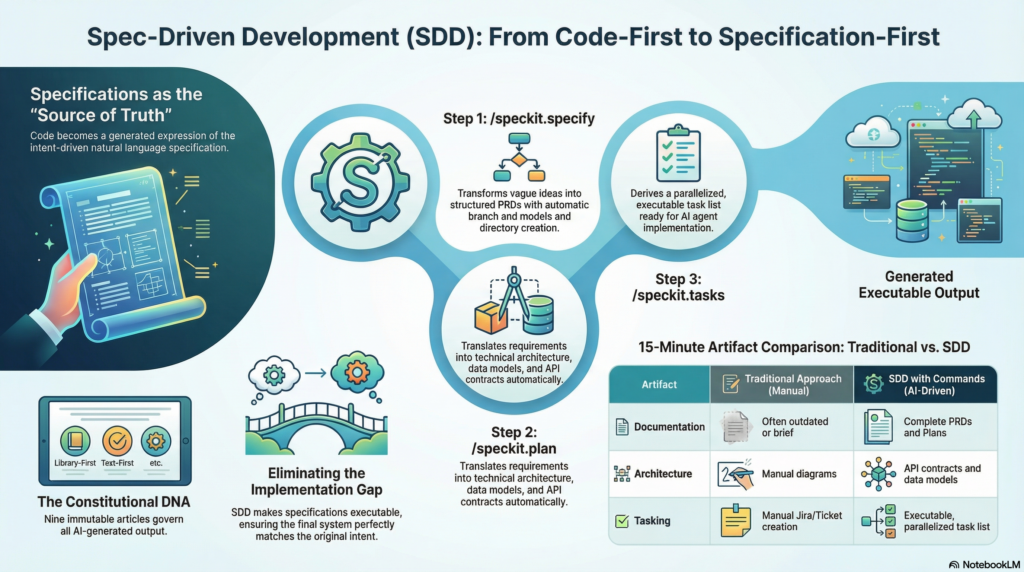
The most profound shift in SDD is the “Power Inversion.” For decades, code was king. Specifications served code, providing just enough context for a human to begin typing. In the age of AI, this hierarchy is obsolete. We are no longer writing code for humans to read; we are defining requirements for AI to execute.
As the core methodology asserts: “Specifications don’t serve code—code serves specifications. The Product Requirements Document (PRD) isn’t a guide for implementation; it’s the source that generates implementation.”
When specifications and implementation plans are precise enough to generate the system, code becomes the “last-mile approach”—a mere expression of the truth in a particular language or framework. This eliminates the “out-of-sync” nightmare because the implementation is a direct, automated transformation of the specification. If the requirements change, the code is regenerated, not patched.
If specifications are the engine, the “Constitutional Foundation” (memory/constitution.md) is the guardrail. It is a common misconception that LLMs need total freedom to be “creative.” In reality, an LLM without constraints produces “code soup”—an unmaintainable mess of hallucinations and inconsistent patterns.
SDD relies on the “Nine Articles” to provide an architectural DNA that remains consistent across different AI models. This discipline is enforced through Phase -1 Gates—rigorous checks that prevent the AI from proceeding if it violates core principles. Key articles include:
While the Constitution provides the rules, the Specification Templates provide the discipline to enforce them. The greatest risk in AI-assisted development is the “hallucination of certainty”—when an AI assumes a requirement detail that wasn’t there.
To combat this, SDD templates mandate the use of [NEEDS CLARIFICATION] markers. If a requirement is ambiguous—such as a “login system” that doesn’t specify SSO versus email—the AI is forbidden from guessing. It must flag the uncertainty. This shifts the developer’s role from a “writer” of syntax to a “curator of intent.” Your value is no longer found in your typing speed, but in your ability to resolve ambiguity and exercise critical thinking. You are the editor-in-chief of the system, not the mechanical translator.
In a traditional environment, moving from a feature idea to a solid technical plan can take days of cross-functional meetings. SDD collapses this timeline into minutes using the /speckit command suite:
This isn’t just about speed; it’s about Traceable Decisions. Because the /speckit.plan command forces every technology choice to link back to a requirement in the PRD, the rationale for every architectural decision is documented and versioned. You achieve the holy grail of software architecture: a system where every line of code can be traced back to a specific business need.
In an SDD world, we embrace a “0 -> 1, (1′, ..), 2, 3, N” evolutionary process. Because the cost of generation is low, “starting over” is no longer a dirty word; it’s a standard feature.
This fundamentally changes debugging and refactoring. Debugging means fixing specifications and their implementation plans that generate incorrect code. You don’t fix the bug in the JavaScript; you fix the flaw in the logic of the PRD or the constraints of the Plan.
This supports high-stakes “what-if” simulations. If a business pivot requires you to fundamentally change how a product is sold, you don’t spend months refactoring legacy code. You modify the core requirements in the specification and regenerate the implementation. This systematic regeneration allows for experiments that were previously too expensive or risky to attempt, turning engineering into a tool for business agility rather than a bottleneck.
We are witnessing the end of “mechanical translation.” The historical burden of the developer—taking a human idea and manually translating it into a machine-readable syntax—is being handed over to AI. This moves us toward Intent-Driven Development, where the focus of engineering is the high-level expression of intent through natural language, design assets, and architectural principles.
In this new era, the lingua franca of engineering isn’t Python, Rust, or Go. It is clear, unambiguous intent. Our role as developers is to become more like architects and less like masons—focusing on the integrity of the design and the clarity of the purpose.
If your code were to disappear tomorrow, is your specification clear enough for an AI to rebuild your entire system in an afternoon?